Best AI Tools for Clinical Trial Design Benchmarking (2026)
Linda
Compare the best AI tools for clinical trial design benchmarking. We test Noah AI on STEP 1, SURMOUNT-1, and SURMOUNT-5 to show how design differences affect interpretation.
Clinical trial design benchmarking is not the same as comparing trial results. Before asking which treatment produced a larger efficacy effect, researchers need to understand whether the studies were designed to answer comparable questions.
Two trials in the same disease area can differ in comparator, masking, randomization ratio, population, dose-escalation strategy, treatment duration, endpoint hierarchy, estimand, and handling of treatment discontinuation.
Those design choices determine what conclusions a trial can actually support. AI tools can reduce the manual work involved in reconstructing those features, but their value differs depending on whether the bottleneck is trial discovery, PDF extraction, side-by-side benchmarking, or broader research synthesis.
Evaluation note: We tested Noah AI directly using STEP 1, SURMOUNT-1, and SURMOUNT-5 as a clinical trial design benchmarking case. Other tools were evaluated based on their current official documentation and published workflows.
Best AI Tools for Clinical Trial Design Benchmarking
| Tool | Best Fit | Side-by-Side Trial Benchmarking | Deep Design Extraction | Multi-Source Research | Best When... |
|---|---|---|---|---|---|
| Noah AI | Biomedical trial benchmarking | Strong | Strong | Strong | You want to start with a clinical question and produce a structured, cited comparison of trial designs. |
| Elicit | Larger evidence and decision-support projects | Strong | Strong | Strong | You need to benchmark many studies or build a reusable structured evidence set. |
| Consensus | Focused literature questions | Moderate | Moderate | Mainly academic literature | You want to quickly research trial-design precedents or specific methodological questions. |
| SciSpace | Paper and PDF-level design inspection | Moderate | Strong | Moderate | Important protocol, endpoint, or statistical details are buried inside publications or supplementary files. |
| ChatGPT Deep Research | Broad multi-source benchmarking | Strong | Strong | Strong | The benchmark requires papers, registries, regulatory sources, websites, and uploaded documents. |
| Perplexity Research | Fast trial-landscape orientation | Moderate | Moderate | Strong | You first need to identify the major relevant trials and sources before deeper benchmarking. |
What Should Be Benchmarked in a Clinical Trial Design?
A useful benchmark should compare the design architecture rather than simply extracting headline efficacy numbers.
At minimum, researchers should usually compare:
- trial phase and objective,
- randomization and masking,
- control or comparator type,
- inclusion and exclusion criteria,
- sample size and randomization ratio,
- intervention arms and dose strategy,
- treatment duration,
- primary and key secondary endpoints,
- estimand or analysis strategy,
- safety and treatment-discontinuation handling.
The purpose is not to force every field into a direct comparison. It is to identify which features align and which differences materially affect interpretation.
A Real Benchmark: STEP 1, SURMOUNT-1, and SURMOUNT-5
To test this workflow, we asked Noah AI to benchmark three major obesity trials in adults without type 2 diabetes: STEP 1, SURMOUNT-1, and SURMOUNT-5.
These studies are useful together because their populations and outcome domains are related, while their actual trial-design questions are different.
STEP 1 tested semaglutide against placebo. SURMOUNT-1 tested multiple tirzepatide maintenance doses against placebo. SURMOUNT-5 moved to a direct active-comparator design comparing tirzepatide with semaglutide.
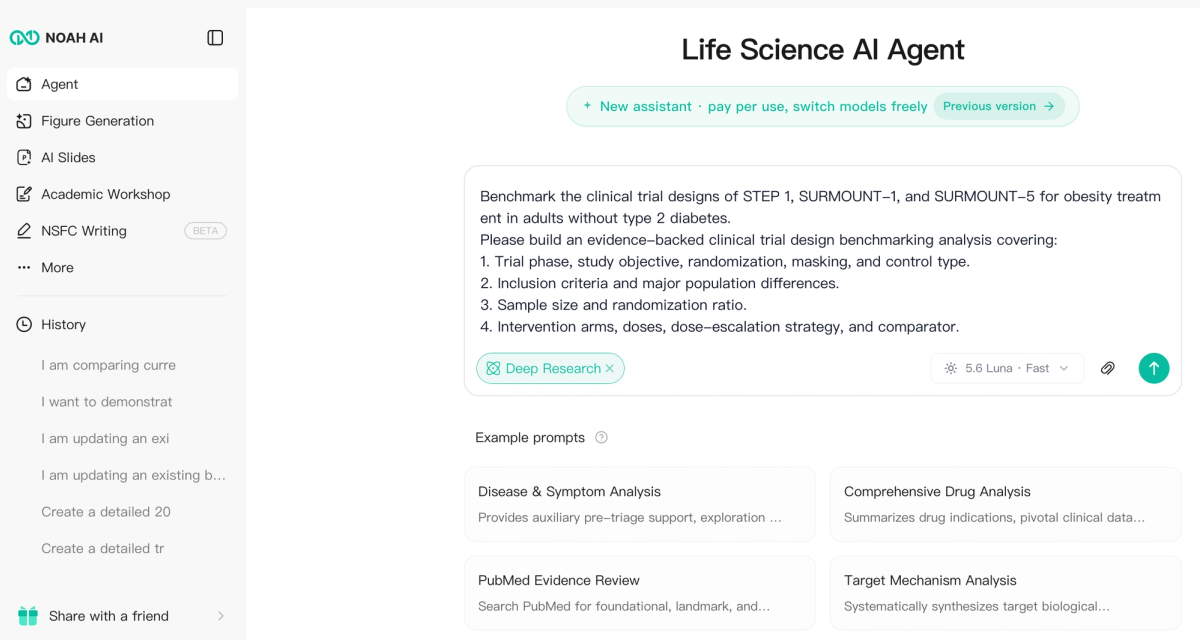
A clinical trial design benchmarking prompt entered into Noah AI for STEP 1, SURMOUNT-1, and SURMOUNT-5.
What Noah Made Easier to Compare
Noah aligned the three studies across the same design fields instead of returning three separate trial summaries.
The resulting table compared:
- phase, objective, randomization, masking, and control,
- population and inclusion criteria,
- sample size and allocation ratio,
- intervention arms, doses, and comparator,
- treatment duration,
- primary and secondary efficacy endpoints.
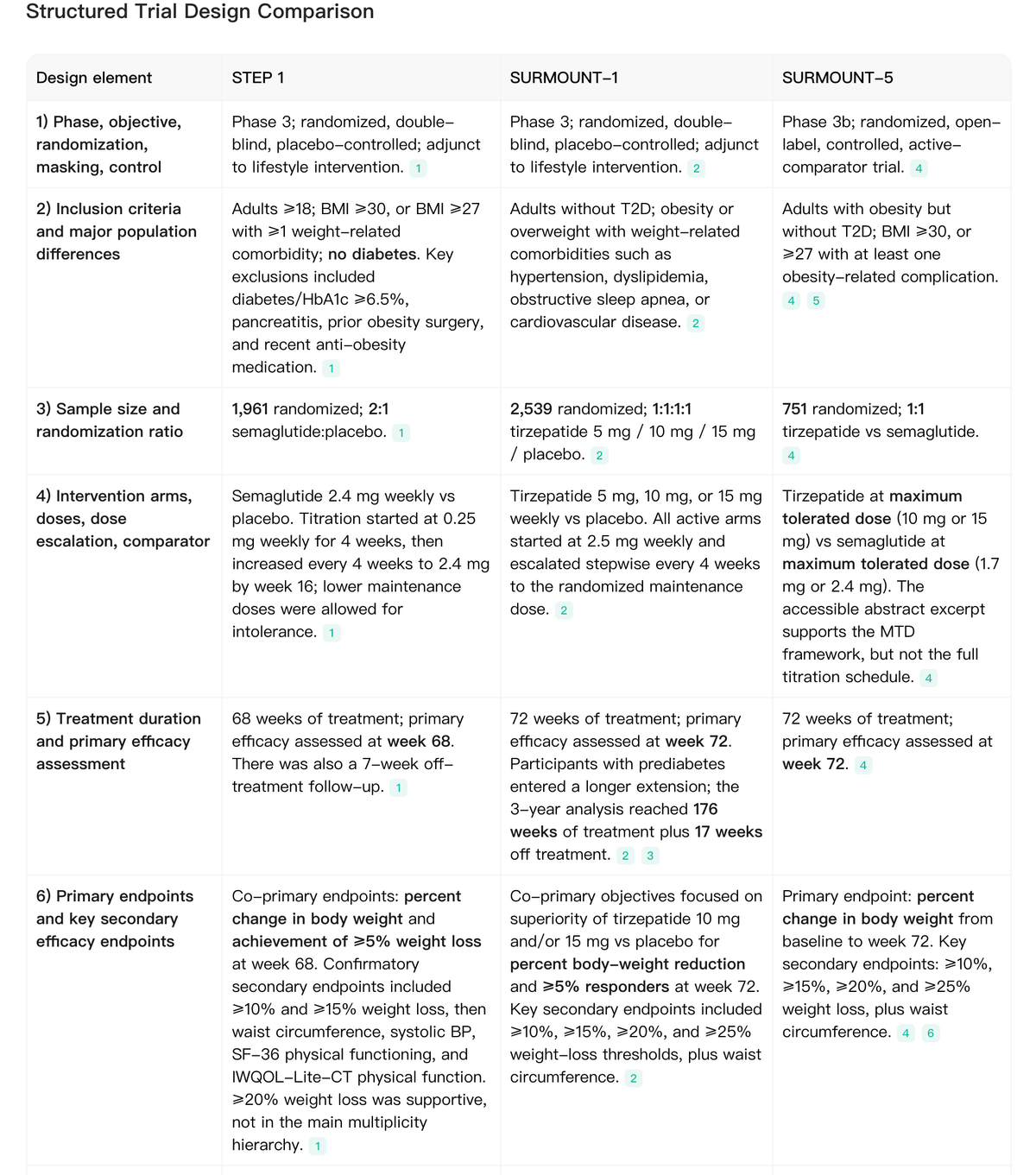
Noah AI benchmarks the core design features of STEP 1, SURMOUNT-1, and SURMOUNT-5 side by side.
Benchmark Trial Designs with Noah AI
Compare trial populations, randomization, comparators, treatment arms, dosing strategies, endpoints, and study duration in one structured, cited workflow.
Start for free with included usage credits — no credit card required.
Benchmark Trial Designs with Noah AI →
Three Design Differences That Matter
1. Placebo-Controlled Evidence vs Active Comparison
STEP 1 and SURMOUNT-1 were randomized, double-blind, placebo-controlled phase 3 trials.
Their primary role was to establish whether the intervention produced clinically meaningful benefit relative to placebo within the studied population.
SURMOUNT-5 asked a different question. It was a phase 3b, randomized, open-label, active-comparator study directly comparing tirzepatide and semaglutide.
A placebo-controlled trial asks whether the intervention works relative to an inactive control. An active-comparator trial asks how one treatment performs relative to another treatment.
Those designs should not be treated as interchangeable.
2. Dose Architecture Changes What the Trial Can Answer
STEP 1 evaluated semaglutide with escalation toward a 2.4 mg weekly maintenance dose.
SURMOUNT-1 included separate tirzepatide 5 mg, 10 mg, and 15 mg maintenance groups, allowing the development program to characterize efficacy across different dose levels.
SURMOUNT-5 used a maximum tolerated-dose framework for both drugs. That design was more aligned with a practical head-to-head effectiveness question than with dose-response characterization.
3. Similar Endpoints Do Not Make the Trials Identical
All three studies centered on percentage change in body weight, but endpoint structure differed.
STEP 1 and SURMOUNT-1 included percentage weight change and achievement of at least 5% weight loss as major co-primary objectives.
SURMOUNT-5 used percentage change in body weight as the primary endpoint, with higher weight-loss thresholds such as 10%, 15%, 20%, and 25% included among key secondary outcomes.
This is why endpoint names alone are not enough for design benchmarking. The hierarchy and inferential framework also matter.
A Faster Way to Read the Three Designs
| Design Question | STEP 1 | SURMOUNT-1 | SURMOUNT-5 |
|---|---|---|---|
| Control | Placebo | Placebo | Semaglutide |
| Masking | Double-blind | Double-blind | Open-label |
| Randomized participants | 1,961 | 2,539 | 751 |
| Allocation | 2:1 | 1:1:1:1 | 1:1 |
| Primary assessment | Week 68 | Week 72 | Week 72 |
| Main design purpose | Establish semaglutide efficacy vs placebo | Establish tirzepatide efficacy and characterize multiple dose levels | Directly compare tirzepatide with semaglutide |
How the Tools Compare in Practice
Noah AI: Best for a Question-to-Benchmark Workflow
Noah AI is most useful here when the researcher already knows the benchmarking question and wants to move directly from that question into a structured, cited clinical comparison.
Noah's advantage in this example is not simply retrieving STEP 1, SURMOUNT-1, and SURMOUNT-5.
The useful step is aligning those trials into common fields so differences in population, treatment arms, randomization, endpoints, and duration become visible in one research output.
Noah also has a Clinical Results workflow for filtering and reviewing trial-result data by fields such as drug, target, indication, company, and phase, then using AI to compare selected trial records.
Related Noah guide: How to Analyze Clinical Trial Results with AI Using Noah AI.
Elicit: Best for Larger Benchmarking Datasets
Elicit is particularly relevant when trial benchmarking is part of a larger evidence-development or decision-support project.
Its Research Agent can search across scientific literature and other sources, extract structured evidence, and build tables and reports.
That makes it useful when the benchmark contains many trials rather than three or four hand-selected studies.
Official documentation: Introducing Elicit Research Agent.
Consensus: Best for Investigating Individual Design Questions
Consensus works well when the benchmarking task can be broken into focused academic research questions.
Examples include:
- Which phase 3 obesity trials used an active comparator?
- Which body-weight responder thresholds are commonly used?
- How do obesity trials handle treatment discontinuation?
- Which studies report specific estimand approaches?
It is useful for identifying design precedents before a complete benchmark is assembled.
Official documentation: Consensus Deep Review.
SciSpace: Best for Extracting Details Buried in Trial Papers
Trial-design benchmarking often fails because the important design fields are not all available in the abstract.
Eligibility criteria, titration schedules, statistical methods, endpoint hierarchies, and supplementary analyses may require reading the full publication or supplementary files.
SciSpace is most useful at this stage: reading papers, extracting methodologies, and interrogating PDFs before the data are added to a benchmark.
Official documentation: How to Conduct a Literature Review Using SciSpace.
ChatGPT Deep Research: Best for Broad Multi-Source Benchmarking
Some benchmarking tasks require more than publications. Trial registries, regulatory material, protocols, websites, and uploaded files may all contribute useful design information.
ChatGPT Deep Research is useful when the evidence needs to be assembled across those different source types before being turned into a documented report.
Official documentation: Deep research in ChatGPT.
Perplexity Research: Best for Finding the Benchmark Set Quickly
Perplexity Research is more useful at the beginning of the workflow: identifying major trials, locating sources, and mapping the relevant evidence before detailed extraction begins.
This makes it suitable for early orientation, especially when the researcher is not yet certain which studies belong in the benchmark.
Official documentation: Perplexity Research.
Which Tool Is Best for Which Benchmarking Problem?
Choose Noah AI when you want to start with a biomedical trial question and produce a structured, cited side-by-side comparison.
Choose Elicit when you need repeated structured extraction across a larger set of trials.
Choose Consensus when the first job is researching individual design precedents from academic literature.
Choose SciSpace when critical design details need to be extracted from full papers and PDFs.
Choose ChatGPT Deep Research when the evidence spans multiple public and uploaded source types.
Choose Perplexity Research when you need to identify the relevant trial set quickly before deeper review.
A Practical Trial Design Benchmarking Workflow
1. Start with the design question. Decide whether you are benchmarking endpoints, comparator choice, patient selection, dose strategy, duration, or the entire protocol.
2. Select genuinely relevant precedent trials. Similar disease names alone are not enough.
3. Create a common extraction framework. Every included trial should contribute the same core design fields.
4. Verify detailed fields against primary sources. Use the trial publication, protocol, registry, or statistical documentation rather than relying only on secondary summaries.
5. Mark design differences that affect interpretation. Active versus placebo comparator, open-label versus blinded design, dose structure, and estimand differences should not disappear during summarization.
6. Use the benchmark to inform the new design question. The goal is not to copy another trial. It is to understand which precedents are relevant and why.
Frequently Asked Questions
What is clinical trial design benchmarking?
Clinical trial design benchmarking compares how relevant studies were constructed, including population, intervention, comparator, randomization, masking, treatment duration, endpoints, and statistical strategy.
Can AI compare clinical trial designs?
Yes. AI can help identify trial-design information and align fields across multiple studies. Important design details should still be verified against original publications, registries, protocols, and other primary sources.
What is the difference between design benchmarking and trial result comparison?
Trial result comparison focuses on outcomes such as efficacy and safety. Trial design benchmarking focuses on how those results were generated and whether the studies are structurally comparable.
Why is comparator choice important in trial benchmarking?
A placebo-controlled trial and an active-comparator trial answer different clinical questions. Comparator choice changes both the evidentiary standard and how the final effect estimate should be interpreted.
Can AI help benchmark clinical trial endpoints?
Yes. AI can help compare endpoint definitions, timing, responder thresholds, and hierarchy across trials, although the exact definitions should be checked against original study documentation.
Can clinical trial design benchmarking replace protocol-development expertise?
No. Benchmarking provides evidence and precedent. Actual protocol design still requires clinical, statistical, regulatory, ethical, and operational judgment.
Final Takeaway
Clinical trial design benchmarking is useful because it forces researchers to understand how evidence was generated before comparing what the evidence says.
STEP 1, SURMOUNT-1, and SURMOUNT-5 show how studies in the same therapeutic area can answer progressively different questions through changes in control strategy, dose architecture, randomization, and endpoint structure.
Noah AI is particularly relevant when the desired output is a biomedical question-to-benchmark workflow. Elicit is strong for larger structured evidence projects, SciSpace for paper-level design extraction, Consensus for focused academic design questions, and general deep-research tools for broader source discovery.
Benchmark the trial design first. Compare the treatment results second.
Want to benchmark clinical trial designs with the same workflow? Use Noah AI to compare populations, comparators, endpoints, treatment duration, and other design choices across relevant clinical trials.