Best AI Tools for Clinical Guideline Recommendation Comparison (2026)
Linda
Compare the best AI tools for clinical guideline comparison in 2026 using a real USPSTF, ACS, and ACOG breast cancer screening example with guideline dates, age bands, grading language, and source-linked evidence.
Comparing clinical guidelines is harder than collecting several recommendations and placing them side by side.Different organizations may address slightly different populations, use different age bands, apply different recommendation-grading systems, weigh benefits and harms differently, or update individual parts of a guideline at different times.An AI tool can make this process faster, but a useful guideline-comparison workflow needs to preserve those differences rather than compress them into a single simplified answer.For this guide, we tested Noah AI directly on a real clinical question: comparing breast cancer screening recommendations for average-risk women from three U.S. organizations using the following source versions:
- USPSTF: Breast Cancer: Screening — Final Recommendation Statement, published April 30, 2024.
- American Cancer Society (ACS): Breast Cancer Screening for Women at Average Risk: 2015 Guideline Update; the official ACS recommendation page was last revised July 23, 2026.
- American College of Obstetricians and Gynecologists (ACOG): Practice Bulletin No. 179, Breast Cancer Risk Assessment and Screening in Average-Risk Women, with an interim screening update published October 10, 2024.
The goal was not to decide which guideline is “best.”The goal was to see whether AI could help:
- identify the relevant official guideline sources;
- extract recommendation-level details;
- align recommendations across organizations;
- preserve original grading terminology;
- distinguish meaningful clinical differences from differences caused by wording or framework;
- and keep missing or inaccessible information visible.
Testing note: We tested Noah AI directly. Consensus, OpenEvidence, Elicit, and Scite are described based on their official documentation and documented research workflows rather than a same-task benchmark performed for this article.
Best AI Tools for Clinical Guideline Comparison at a Glance
Different tools are useful at different stages of a guideline-comparison workflow.
| Tool | Useful For | How It Fits a Guideline Comparison Workflow | Basis in This Article |
|---|---|---|---|
| Noah AI | Structured biomedical guideline comparison | Useful for organizing recommendation-level details, source-linked evidence, age bands, grading language, missing fields, and differences across guidelines in one research workflow | Tested directly |
| Consensus | Medical literature and guideline discovery | Useful for locating relevant guideline and medical-literature sources before a structured comparison is built | Official documentation |
| OpenEvidence | Clinical evidence and guideline-informed context | Useful for investigating clinical questions and locating relevant evidence or guideline-supported context | Official documentation |
| Elicit | Research evidence behind recommendations | Useful for searching, screening, extracting, and synthesizing underlying studies when guideline recommendations differ | Official documentation |
| Scite | Citation context around important studies | Useful for examining how key publications have subsequently been supported, contrasted, or discussed in later literature | Official documentation |
The tools serve different purposes.For the detailed three-organization comparison below, we tested Noah AI directly. The descriptions of Consensus, OpenEvidence, Elicit, and Scite indicate where they may be useful in the broader workflow rather than claiming that we tested them on the same breast cancer screening task.
What Makes Clinical Guideline Comparison Difficult?
A clinical guideline recommendation is more than one sentence saying what clinicians should do.A recommendation may depend on:
- the exact target population;
- age or disease stage;
- risk category;
- intervention or screening modality;
- recommended frequency;
- stopping criteria;
- exceptions;
- shared decision-making language;
- recommendation strength;
- certainty of evidence;
- and the exact guideline version or update date.
If AI extracts only the headline recommendation, clinically meaningful differences can disappear.The opposite problem is also common.Two recommendations may appear different because one organization separates patients into several age groups while another uses one broad age range.That is not necessarily a true clinical disagreement.A useful comparison therefore needs to answer two separate questions:1. What exactly does each organization recommend in the source version being analyzed?2. Are the differences clinically meaningful, or are they caused by wording, scope, age grouping, source availability, or different grading systems?
1. Noah AI — Structured Guideline Recommendation Analysis
Noah AI is designed around medical, life-science, and biomedical research workflows.For this test, we used the Medical & Academia category with Deep Research.Instead of asking Noah to simply:
Compare breast cancer screening guidelines.
we defined:
- the organizations;
- target population;
- evidence cutoff;
- exact comparison dimensions;
- output structure;
- source requirements;
- and rules for handling missing information and recommendation grades.
This matters because clinical guideline comparison is fundamentally a structured research problem.The requested workflow included:
- identifying the relevant official guideline source and version;
- extracting recommendation-level details;
- comparing USPSTF, ACS, and ACOG across the same dimensions;
- preserving each organization’s original grading terminology;
- separating meaningful differences from apparent differences;
- marking inaccessible or unverified fields as NR, uncertain, or not verified;
- and keeping citations attached to recommendation-specific claims.
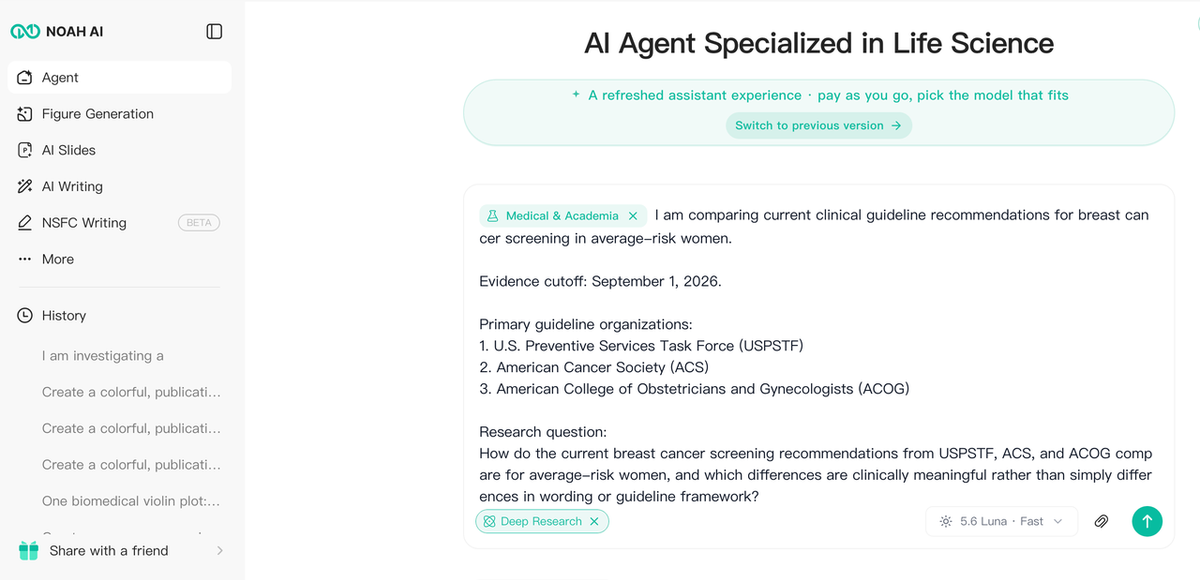
The practical value is not an automatic “winner” between guidelines.It is the ability to turn a focused medical research question into a structured, source-traceable comparison that can still be reviewed by the researcher.For a broader multi-step workflow, see Best AI Tools for Medical Research Workflow Automation (2026).
2. Consensus — Useful for Medical Literature and Guideline Discovery
Consensus may be useful when the first challenge is finding relevant medical evidence and guideline material.For a guideline-comparison project, its most relevant role is often discovery:
- locating guideline-related sources;
- identifying supporting medical literature;
- and helping researchers move from a broad clinical question toward a smaller evidence set.
That does not mean a discovery tool will automatically preserve every age band, recommendation grade, stopping criterion, or non-comparable field required for a detailed multi-guideline matrix.Those dimensions still need to be explicitly defined in the research workflow.A researcher may therefore use one platform for evidence discovery and another structured workflow for recommendation-level comparison.
3. OpenEvidence — Useful for Clinical Evidence and Guideline-Informed Questions
OpenEvidence is oriented toward clinician-facing medical evidence and clinical questions.It may be useful when the researcher needs to investigate a clinical question and identify relevant guideline-supported context or medical evidence.For a project whose final deliverable requires a detailed matrix across three organizations—including:
- age bands;
- frequency;
- starting criteria;
- stopping criteria;
- recommendation language;
- grading terminology;
- and missing fields—
those extraction dimensions should still be defined explicitly.A general clinical response should not be assumed to preserve every recommendation-level distinction automatically.
4. Elicit — Useful for Examining the Evidence Behind Recommendations
Elicit may be useful when the research task shifts from:
What does the guideline recommend?
to:
What evidence may have contributed to the recommendation?
Its literature-review workflows are relevant when researchers need to examine the underlying research literature behind differences between guideline organizations.For example, if two organizations recommend different screening intervals, the next research task may involve reviewing:
- screening trials;
- modeling studies;
- benefit-harm analyses;
- observational evidence;
- or studies of false-positive results and overdiagnosis.
That underlying evidence review is related to guideline comparison, but it is not the same task as extracting the recommendation itself.For a broader literature-review workflow, see Best AI Tools for PubMed Literature Review (2026).
5. Scite — Useful for Citation Context Around Key Studies
Scite may be useful as a citation-context layer when a guideline depends on an important publication and the researcher wants to understand how that study has subsequently been discussed.Its most relevant role here is not automatic extraction of multiple guideline recommendations.Instead, it may be useful for investigating questions such as:
- How has a key screening study been cited later?
- Have later papers supported or challenged a specific interpretation?
- Has an influential evidence source generated substantial disagreement?
That makes Scite more relevant to verification and citation context than to a complete multi-guideline extraction workflow.
Real Workflow: Comparing Breast Cancer Screening Guidelines with Noah AI
To make the comparison concrete, we used a real clinical question involving breast cancer screening recommendations for average-risk women.The comparison covered:
- USPSTF — Final Recommendation Statement, April 30, 2024
- ACS — 2015 Guideline Update; official recommendation page revised July 23, 2026
- ACOG — Practice Bulletin No. 179 with interim update published October 10, 2024
This case works well because the organizations broadly agree that mammography is central to screening average-risk women, but meaningful differences remain in:
- starting framework;
- age-specific recommendations;
- screening interval;
- stopping approach;
- shared decision-making;
- and recommendation terminology.
Step 1: Define the Population Before Comparing Recommendations
The first step is to prevent high-risk and average-risk screening pathways from being mixed together.Our Noah prompt focused the primary comparison on average-risk women.It excluded separate high-risk pathways where relevant, including those involving:
- known high-risk genetic syndromes;
- previous high-dose chest radiation;
- previous breast cancer;
- and other clearly elevated-risk situations.
This distinction matters.A routine mammography recommendation for an average-risk population cannot be directly compared with an MRI-based surveillance pathway for someone with substantially elevated hereditary risk.Population definition therefore comes before recommendation comparison.
Step 2: Identify the Relevant Official Guideline Version
Guideline comparison should start by recording the exact recommendation source and date used in the analysis.For this example, the source versions were:
Organization
Source Version Used
Date / Update
USPSTF
Breast Cancer: Screening — Final Recommendation Statement
April 30, 2024
ACS
Breast Cancer Screening for Women at Average Risk: 2015 Guideline Update
2015 guideline; official recommendation page last revised July 23, 2026
ACOG
Practice Bulletin No. 179 with interim screening update
October 10, 2024 interim update
| Organization | Source Version Used | Date / Update |
|---|---|---|
| USPSTF | Breast Cancer: Screening — Final Recommendation Statement | April 30, 2024 |
| ACS | Breast Cancer Screening for Women at Average Risk: 2015 Guideline Update | 2015 guideline; official recommendation page last revised July 23, 2026 |
| ACOG | Practice Bulletin No. 179 with interim screening update | October 10, 2024 interim update |
This version information should remain visible throughout the comparison.Avoid undated phrases such as:
the current USPSTF recommendation
when the exact recommendation date can be stated.A dated label is more durable because the article may remain indexed after a future update.For ACOG, the 2024 interim update specifically changed the starting-age recommendation.Where a more detailed field could not be verified from the specific accessible source material used in the Noah workflow, it remained NR, uncertain, or not verified instead of being silently filled from another organization’s framework.Missing evidence should remain missing.
Step 3: Normalize the Recommendation Dimensions
Once the source versions are identified, the recommendations need to be compared using the same dimensions.We asked Noah to align:
- starting age;
- ages 40–44;
- ages 45–54;
- ages 55–74;
- screening frequency;
- screening modality;
- stopping criteria;
- shared decision-making;
- dense-breast considerations;
- recommendation strength;
- evidence uncertainty;
- and source version.
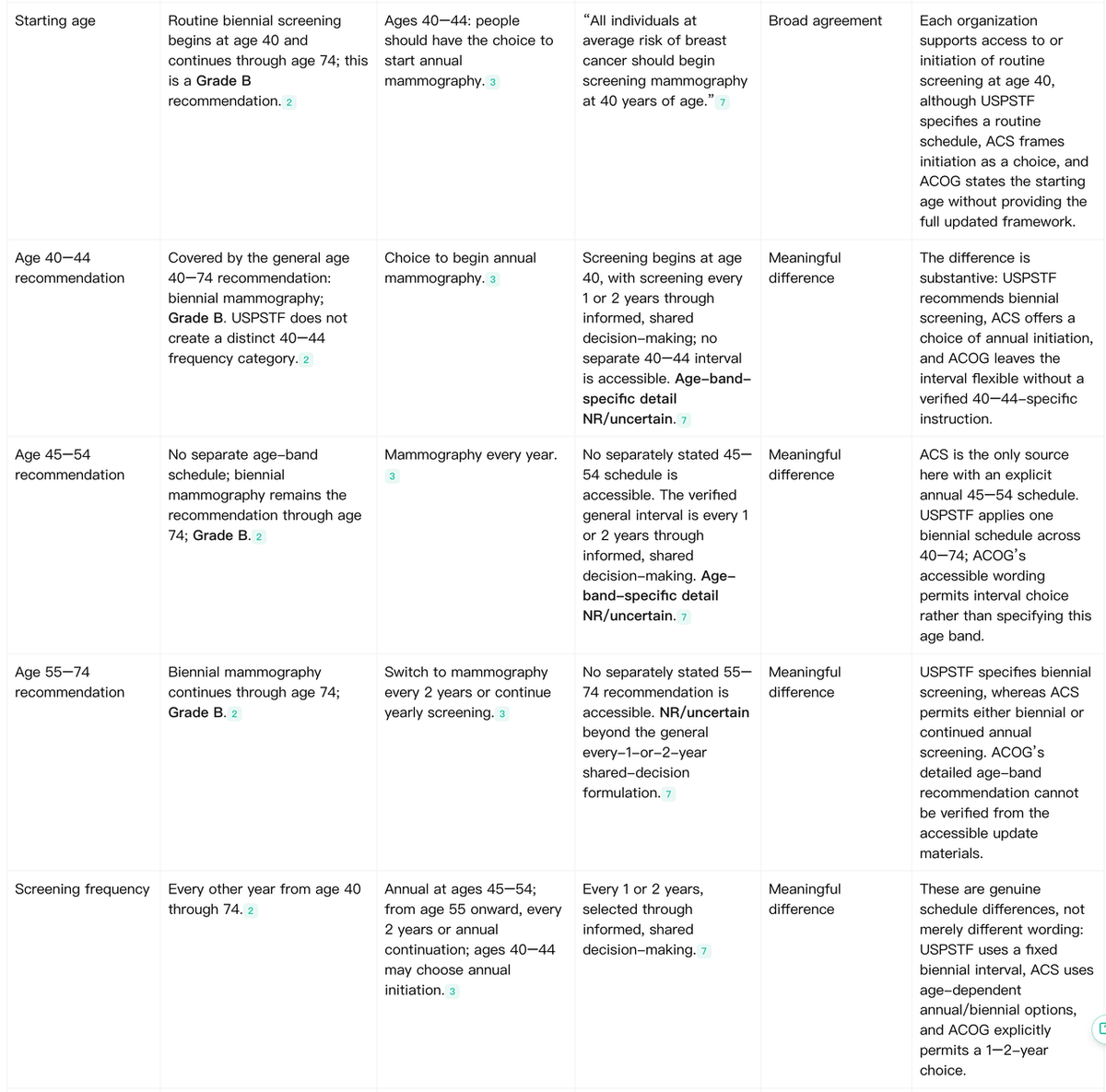
A simplified comparison looks like this:
| Dimension | USPSTF — Apr 30, 2024 | ACS — 2015 Update / Page Revised Jul 23, 2026 | ACOG — Oct 10, 2024 Interim Update |
|---|---|---|---|
| Average-risk starting framework | Routine biennial screening begins at 40 | Routine biennial screening begins at 40 Ages 40–44 have the option to begin annual screening | Screening begins at age 40 |
| Ages 40–44 | Biennial mammography | Option to begin annual mammography | Screening begins at 40; interval based on shared decision-making |
| Ages 45–54 | Biennial mammography | Annual mammography | Mammography every 1 or 2 years |
| Age 55+ | Biennial through age 74 | Biennial or continued annual screening | 1- or 2-year interval in the recommendation framework analyzed |
| Modality | Mammography | Mammography | Mammography |
| Stopping approach | Evidence insufficient for routine recommendation at age 75+ | Continue while in good health and expected to live at least 10 more years | Detailed stopping language should be tied to the specific ACOG source used; do not infer from another organization |
| Shared decision-making | Clinical judgement remains relevant, especially where evidence is insufficient | Choice incorporated in several age-dependent recommendations | Central to interval selection |
| Recommendation terminology | Grade B; I statements for selected insufficient-evidence questions | Strong and qualified recommendations | Preserve ACOG’s own evidence-level terminology where verified |
| Version label | Apr 30, 2024 | 2015 update; official page revised Jul 23, 2026 | Oct 10, 2024 interim update |
The matrix shows why guideline comparison cannot stop at:
All three organizations recommend mammography.
The operational schedules and decision frameworks differ.
Step 4: Compare Starting Age and Screening Frequency
The organizations show substantial common ground around age 40, but the operational meaning is different.
USPSTF — April 30, 2024
USPSTF recommends biennial screening mammography from ages 40 through 74.This is a routine population-level recommendation rather than an optional starting window for ages 40–44.
ACS — 2015 Guideline Update; Official Page Revised July 23, 2026
ACS uses an age-dependent schedule:
- women aged 40–44 have the option to begin annual mammography;
- women aged 45–54 should undergo annual mammography;
- women aged 55 and older may transition to biennial screening or continue annual screening.
This creates a different implementation pathway from USPSTF.
ACOG — October 10, 2024 Interim Update
ACOG’s 2024 interim update recommends beginning screening mammography at age 40 for average-risk individuals.The recommendation framework uses a one- or two-year screening interval based on informed shared decision-making.These differences affect real scheduling decisions.They are therefore more than cosmetic wording changes.
Step 5: Separate Real Disagreement From Apparent Disagreement
This is one of the most important steps in guideline comparison.A structured comparison should separate genuinely different clinical instructions from differences caused by document structure or wording.
Routine Screening vs Choice at Ages 40–44
For ages 40–44:
- USPSTF (2024) includes this age range within its routine biennial recommendation.
- ACS (2015 update) frames annual mammography as an option.
- ACOG (2024 interim update) recommends beginning screening at age 40, with frequency determined within its shared decision-making framework.
This is a meaningful implementation difference.
Annual vs Biennial vs One-to-Two-Year Screening
The screening interval also differs.
- USPSTF (2024): biennial screening from ages 40–74.
- ACS (2015 update): annual screening at ages 45–54, then annual or biennial screening from age 55 onward.
- ACOG (2024 interim update): screening every one or two years based on informed shared decision-making.
These recommendations should not be rewritten as though all three organizations recommend exactly the same interval.The more useful synthesis is:
The organizations broadly agree on mammography as the central screening modality but differ in how screening is initiated and scheduled across age groups.
Step 6: Preserve the Original Grading Framework
One of the easiest ways to create a misleading guideline comparison is to force every organization into one grading scale.USPSTF, ACS, and ACOG do not use interchangeable recommendation systems.
Organization
Terminology Used in the Source Framework
How to Handle It in Comparison
USPSTF — 2024
Letter grades including Grade B and I statement
Preserve the USPSTF grade directly
ACS — 2015 update
Strong recommendation and qualified recommendation
Preserve ACS terminology rather than converting it to a USPSTF grade
ACOG
ACOG evidence/recommendation framework
Preserve only terminology verified in the source used; mark unavailable fields as NR rather than inventing a crosswalk
| Organization | Terminology Used in the Source Framework | How to Handle It in Comparison |
|---|---|---|
| USPSTF — 2024 | Letter grades including Grade B and I statement | Preserve the USPSTF grade directly |
| ACS — 2015 update | Strong recommendation and qualified recommendation | Preserve ACS terminology rather than converting it to a USPSTF grade |
| ACOG | ACOG evidence/recommendation framework | Preserve only terminology verified in the source used; mark unavailable fields as NR rather than inventing a crosswalk |
For example, USPSTF Grade B should not automatically be rewritten as equivalent to an ACS strong recommendation.The underlying methods and terminology are different.A general rule for AI-assisted guideline comparison is:Preserve the original recommendation system before attempting to interpret differences across organizations.
Step 7: Keep Missing Information Visible
A structured AI output is only useful if it does not silently fill evidence gaps.In the Noah workflow, not every requested field was equally accessible from every source version.Where detailed ACOG information could not be verified from the specific accessible update material being analyzed, Noah kept those fields visible as:
- NR
- uncertain
- or not verified
rather than filling them from:
- an older source without labeling it;
- another organization’s guideline;
- or model inference.
That is preferable to creating a complete-looking table that is not fully source-supported.The same principle applies to:
- literature reviews;
- trial comparisons;
- regulatory comparisons;
- and evidence tables.
For another structured evidence example, see Best AI Tools for Turning Research Questions into Evidence Tables (2026).
What the Guideline Comparison Revealed
The comparison showed both broad agreement and clinically meaningful implementation differences.
| Question | USPSTF — Apr 30, 2024 | ACS — 2015 / Revised Jul 23, 2026 | ACOG — Oct 10, 2024 Update |
|---|---|---|---|
| Should average-risk screening involve mammography? | Yes | Yes | Yes |
| Does routine screening begin at 40? | Yes | Ages 40–44 are an optional annual-start window | Yes |
| Is the interval fixed across the main age range? | Biennial ages 40–74 | No; age-dependent | No; 1 or 2 years through shared decision-making |
| Are age groups structured the same way? | No | No | No |
| Can grading terminology be directly crosswalked? | No | No | No |
| Should missing recommendation fields be inferred? | No | No | No |
The useful conclusion is therefore not:
The guidelines all say the same thing.
Nor is it:
The guidelines fundamentally disagree.
A more accurate synthesis is that the organizations share a broad screening objective while differing in important implementation details.
What to Look for in an AI Tool for Guideline Comparison
When evaluating an AI tool for this task, look beyond whether it can summarize a guideline PDF.
1. Source Traceability
Important recommendation claims should remain connected to the organization or guideline source from which they were extracted.A comparison becomes difficult to audit when claims lose their source.
2. Version Awareness
Clinical recommendations change.A useful output should record:
- organization;
- guideline or recommendation title;
- publication date;
- update date;
- and any focused interim update used in the analysis.
Avoid undated labels such as:
current guideline
when the exact source date can be provided.
3. Population Preservation
Average-risk, high-risk, adult, pediatric, treatment-naive, refractory, and biomarker-selected populations should not be merged simply because the disease or screening topic is the same.
4. Recommendation-Level Extraction
A useful comparison should capture the actual recommendation rather than summarizing an entire guideline chapter into one sentence.
5. Original Grading Terminology
Organization-specific recommendation grades should remain intact unless a validated crosswalk exists.
6. Explicit Uncertainty
Fields that are:
- not reported;
- inaccessible;
- insufficiently supported;
- or not verified
should remain visible.
7. Structured Comparison Outputs
Tables and matrices are particularly useful when several organizations need to be compared across the same dimensions.
Common Mistakes When Comparing Clinical Guidelines with AI
Using Outdated Guideline Versions
Older guideline pages may remain highly visible in search results even after an organization publishes a focused update.Always record:
- the original guideline date;
- the update date;
- and which source was actually used.
For example, this article does not simply refer to a “current ACOG recommendation.”It specifies the October 10, 2024 interim update used for the starting-age recommendation.
Mixing Average-Risk and High-Risk Recommendations
Routine mammography recommendations should not be mixed with separate surveillance pathways for:
- hereditary cancer syndromes;
- previous high-dose chest radiation;
- previous breast cancer;
- or other substantially elevated-risk groups.
Forcing Different Grading Systems Onto One Scale
USPSTF Grade B, an ACS qualified recommendation, and terminology used by ACOG do not automatically represent equivalent levels of recommendation strength or evidence certainty.Preserve the original language.
Treating Missing Data as a Negative Recommendation
If a recommendation cannot be verified, report:
- NR
- uncertain
- or not verified
Do not interpret missing information as evidence that an organization recommends against something.
Calling Every Wording Difference a Conflict
Different age-group structures, document scopes, and wording conventions can create apparent differences without producing genuinely different clinical instructions.
Comparing Secondary Summaries Instead of Official Sources
Secondary summaries are useful for orientation.Recommendation wording should still be checked against the relevant official organization source whenever possible.
When Should You Use a Guideline Comparison Instead of a Literature Review?
They answer different questions.A guideline comparison asks:
What do different professional or public-health organizations recommend in the source versions being analyzed?
A literature review asks:
What does the underlying research evidence show?
Sometimes both are needed.A researcher may first compare guidelines, identify an important difference, and then review the underlying evidence to understand why the organizations reached different recommendations.If the task shifts toward primary literature retrieval, see PubMed Search with AI.
Frequently Asked Questions
Can AI Compare Clinical Guidelines?
AI can help retrieve, extract, organize, and compare guideline recommendations when the research question and extraction dimensions are clearly defined.Researchers should still verify:
- recommendation wording;
- version and update dates;
- source access;
- grading terminology;
- and clinically important differences
against the relevant official source.
What Should Be Compared Between Clinical Guidelines?
Useful dimensions include:
- target population;
- intervention;
- starting criteria;
- age or disease stage;
- frequency or dose;
- stopping criteria;
- exceptions;
- shared decision-making language;
- recommendation strength;
- evidence certainty;
- and publication or update date.
Can Recommendation Grades From Different Organizations Be Compared Directly?
Not automatically.Different organizations may define recommendation strength and evidence certainty differently.Original terminology should be preserved unless an explicit and methodologically valid crosswalk exists.
How Should AI Handle Missing Guideline Information?
Missing or inaccessible information should remain visible as:
- NR;
- uncertain;
- not reported;
- or not verified.
AI should not infer one organization’s recommendation from another guideline or silently fill an inaccessible field.
Can AI Decide Which Clinical Guideline Is Better?
That is usually not the most useful task.A better workflow identifies:
- how recommendations differ;
- what populations they address;
- which source versions were used;
- which grading systems apply;
- and where uncertainty remains.
Which guideline is used in practice may also depend on jurisdiction, professional standards, institutional policy, clinical context, and patient-specific factors.
Is Guideline Comparison the Same as Evidence Synthesis?
No.Guideline comparison focuses on recommendation statements issued by different organizations.Evidence synthesis examines the underlying research studies.A complete research workflow may use both.
Final Takeaway
Clinical guideline comparison is not a matter of asking AI to summarize three documents.The professional task is to preserve the context that determines what each recommendation actually means:
- population;
- age or disease stage;
- intervention;
- screening frequency;
- exceptions;
- shared decision-making;
- grading framework;
- evidence uncertainty;
- and guideline version.
In this breast cancer screening case, Noah AI helped structure recommendation-level information from:
- the USPSTF April 30, 2024 Final Recommendation Statement;
- the ACS 2015 guideline update, with its official recommendation page revised July 23, 2026;
- and the ACOG October 10, 2024 interim screening update.
The workflow kept meaningful implementation differences visible rather than reducing all three recommendations to:
mammography starting around age 40.
It also preserved unverified information as uncertain instead of manufacturing a complete answer.That is where AI is most useful in guideline work:source identification → version verification → recommendation extraction → structured alignment → uncertainty preservation → human interpretationThe goal is not to replace guideline interpretation.It is to reduce the manual work required to retrieve, align, and organize recommendation-level evidence while keeping the final comparison source-traceable and inspectable.
Compare Clinical Guidelines with Noah AI
Use Noah AI to investigate clinical guidelines, compare recommendation-level details, preserve source versions and grading language, and organize medical evidence into structured, source-linked research outputs.
Free to use · Free credits included · No credit card requiredCompare Clinical Guidelines with Noah AI →