Best AI Tools for Creating Cited Literature Review Reports (2026)
Linda
Compare the best AI tools for creating cited literature review reports in 2026, including Noah AI, Elicit, SciSpace, and Consensus, with a real biomedical report benchmark.
A cited literature review report is more than a long AI summary with references attached at the end.
For researchers, the useful final product is a report that can identify relevant studies, synthesize findings across papers, preserve a clear source trail, surface limitations or uncertainty, and organize the evidence into a document that can actually be reviewed and reused.
That distinction changes how these tools should be compared. The question is not simply which AI tool can search papers or summarize PDFs. The better question is: which tool is best suited to producing the final cited literature review report you actually need?
For biomedical work, Noah AI is particularly strong when the goal is to move from a focused medical research question to a structured, cited report. Elicit is a strong option when the report needs to emerge from a formal systematic-review process. SciSpace offers a broader academic environment combining literature review, extraction, synthesis, and writing. Consensus is especially useful for rapidly exploring and synthesizing peer-reviewed literature around a research question.
What Makes a Good Cited Literature Review Report?
Before comparing tools, it helps to define the final deliverable. A useful cited literature review report should do five things well:
| Criterion | What We Are Looking For |
|---|---|
| Evidence retrieval | Find studies that actually address the research question. |
| Source traceability | Make important claims traceable to a PMID, DOI, paper, trial, or identifiable source. |
| Cross-paper synthesis | Explain what the evidence collectively shows instead of returning isolated paper summaries. |
| Report structure | Organize background, major studies, findings, limitations, uncertainty, and conclusions clearly. |
| Usable final output | Produce something a researcher can review, edit, cite, or reuse downstream. |
Best AI Tools for Cited Literature Review Reports at a Glance
| Tool | Strongest Role in Report Creation | Report Output | Best Fit |
|---|---|---|---|
| Noah AI | Biomedical retrieval → synthesis → cited report | Yes | Biomedical cited reports |
| Elicit | Search → screening → extraction → synthesis/report | Yes | Systematic-review-driven reports |
| SciSpace | Literature review + PDF extraction + cited writing | Yes | Broad academic research workflows |
| Consensus | Evidence-backed search + deep synthesis / review | Yes | Fast evidence-backed literature synthesis |
All four tools can contribute to report creation, but they reach the final output in different ways. The useful comparison is not whether they have overlapping features; it is which workflow is best matched to the report you need to produce.
1. Noah AI — Best for Biomedical Cited Literature Review Reports
Noah AI is designed around life-science and medical evidence work. Its value in this comparison is not simply that it can search literature or run an Agent workflow. The stronger question is whether the final output behaves like a real cited literature review report.
What We Evaluated
We evaluated the final report against the criteria that matter most for a cited literature review: evidence coverage, source traceability, cross-study synthesis, report structure, and practical usability.
The goal was to see whether Noah could turn a focused biomedical research question into a structured, source-traceable report that a researcher could review, verify, and continue editing.
Evidence 1: A Readable Narrative Synthesis
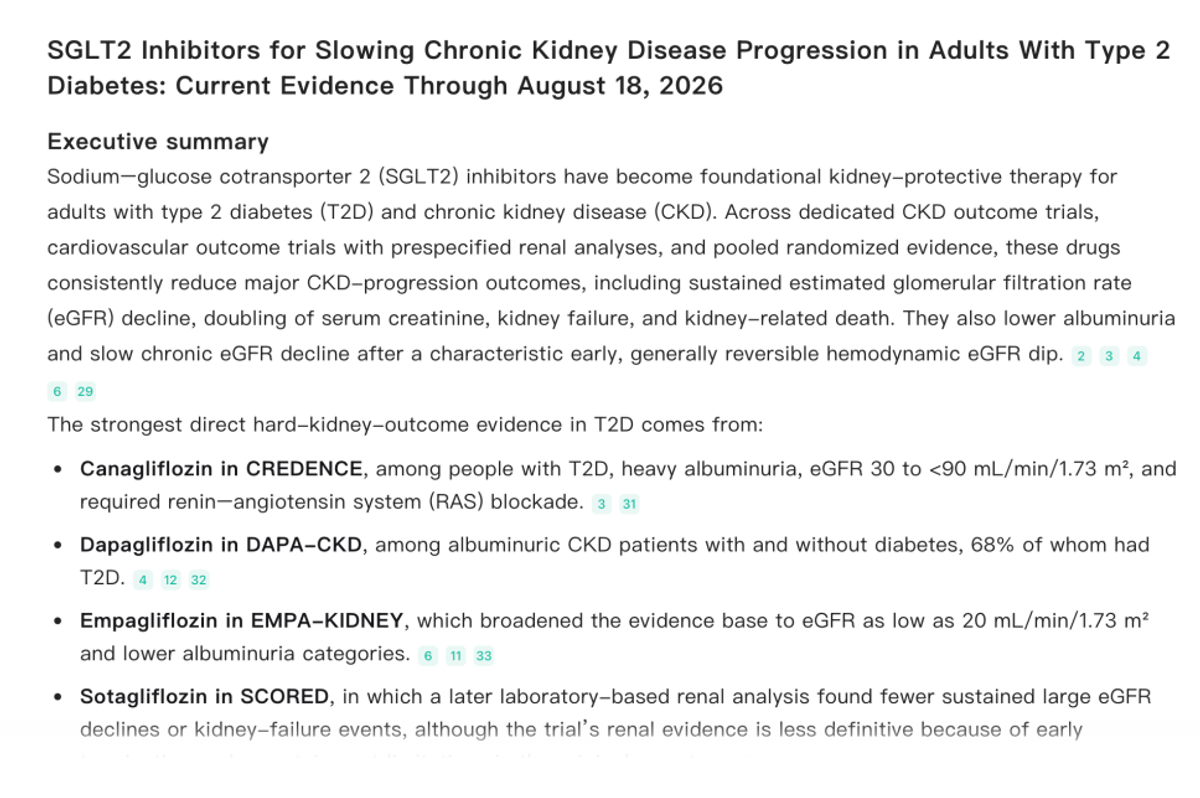
Figure 1. Noah AI narrative literature review output showing an executive summary, cross-trial synthesis, and inline citation markers.
The output begins with an Executive summary rather than simply listing retrieved papers. More importantly, the visible narrative synthesizes evidence across multiple trial programs and attaches citation markers directly to the claims.
The report identifies major evidence from CREDENCE, DAPA-CKD, EMPA-KIDNEY, and SCORED and explains how the populations and strength of renal evidence differ across those trial programs. That matters because a useful literature review should reduce the amount of synthesis the researcher must reconstruct manually from individual paper summaries.
Evidence 2: Structured Trial-Level Evidence
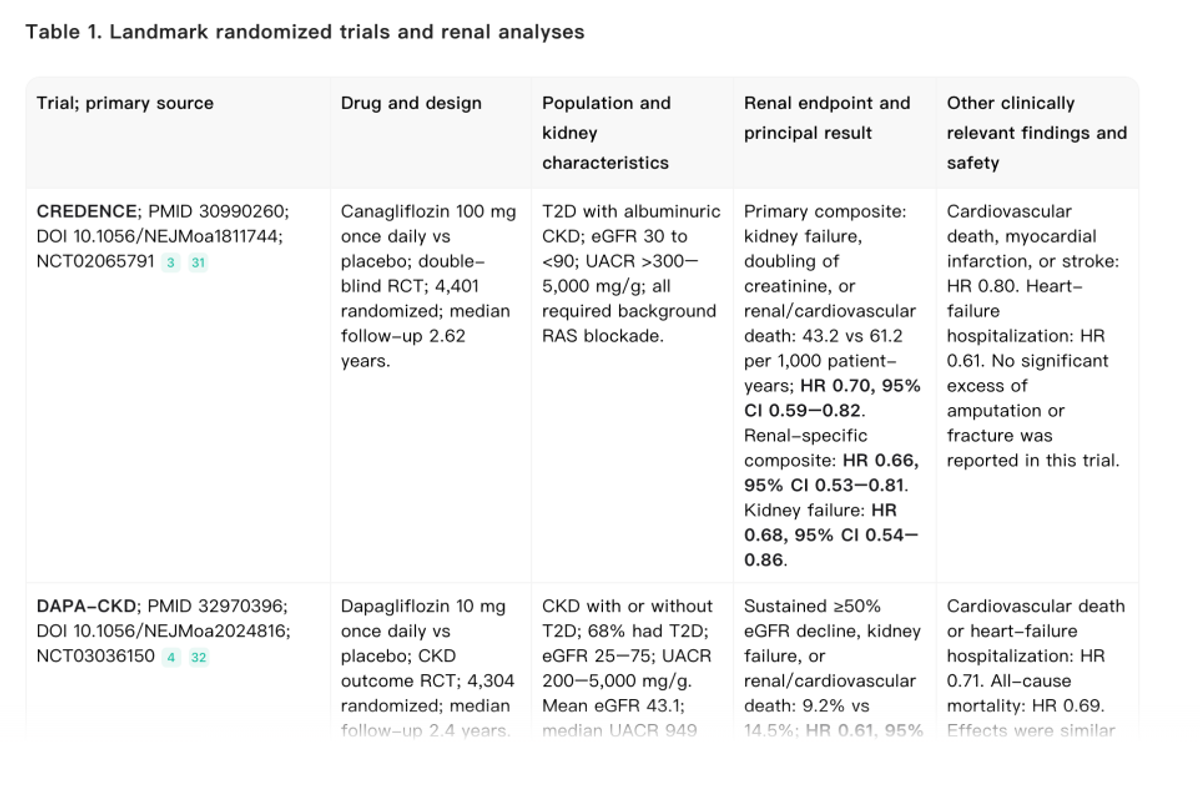
Figure 2. Noah AI structured trial evidence table linking key CKD studies to design, population, renal outcomes, clinically relevant findings, and source identifiers.
The same report also contains a structured evidence section. The visible table includes the trial or primary source, drug and design, patient population, renal endpoint and principal result, clinically relevant findings, and source identifiers such as PMID, DOI, or trial information.
The combination is more useful than either format alone: the narrative makes the report readable, while the evidence table makes the supporting studies easier to inspect.
How Well Did Noah Perform on the Actual Report Task?
Evidence retrieval — Strong. The visible output includes major CKD evidence relevant to SGLT2 inhibitors rather than a random group of related papers.
Source traceability — Strong. Citation markers appear inside the narrative, while the structured trial section preserves identifiable source information.
Cross-paper synthesis — Strong. The report organizes the evidence around the research question and distinguishes differences between important trial populations rather than treating each study as an isolated summary.
Report structure — Strong. The output has a clear title, executive summary, narrative synthesis, trial-level evidence, and report-style organization.
Usability — Strong as a research draft. A researcher starts from a reviewable document rather than a blank page or a spreadsheet of extracted papers.
Important limitation: a cited AI report is still not a verified final manuscript. Trial endpoints, effect sizes, population definitions, citation-to-claim relationships, and interpretations should still be checked against the original sources before publication or decision-making.
What the benchmark actually proves: Noah can move beyond finding papers and produce a biomedical report that combines narrative synthesis, structured trial evidence, and visible source traceability in one reviewable output.
2. Elicit — Best When the Report Comes From a Systematic Review
Elicit should not be described as only an extraction tool before report writing. Its current systematic-review workflow extends from protocol and source gathering through screening, extraction, synthesis, and report generation.
That makes Elicit particularly strong when the final report must emerge from a formal, auditable evidence-selection process.
Choose Elicit when: your workflow depends heavily on predefined inclusion criteria, systematic screening, structured extraction, and reproducible review methodology.
Compared with Noah: the distinction is less “Elicit extracts while Noah writes.” A better distinction is that Elicit is systematic-review-process-first, while Noah is biomedical-question-to-report-first.
If methodological screening is the center of the task, Elicit may be the better fit. If the goal is to begin with a focused biomedical question and quickly reach a cited, structured research output, Noah may be the more direct workflow.
3. SciSpace — Best for a Broad Academic Research Workspace
SciSpace should also be positioned more broadly than “PDF analysis.” Its current research environment spans literature review, PDF-level extraction, synthesis, cited writing, and report generation.
Choose SciSpace when: you want literature discovery, PDF-level analysis, structured extraction, synthesis, and writing inside a general academic research platform.
Compared with Noah: the main difference is domain orientation. SciSpace serves a broad academic workflow, while Noah is more explicitly oriented toward biomedical, medical, and life-science research.
For multidisciplinary researchers, SciSpace’s breadth can be an advantage. For biomedical users who care about trial context, medical evidence, and source-aware biomedical synthesis, Noah’s specialization can be more relevant.
4. Consensus — Best for Fast Evidence-Backed Literature Synthesis
Consensus should no longer be framed only as an early-stage exploration tool. Its deeper research workflows can decompose complex questions, run multiple targeted searches, review large bodies of peer-reviewed literature, and return structured literature syntheses or research reports.
Choose Consensus when: your priority is quickly understanding what the peer-reviewed literature says about a research question and generating a structured synthesis without manually constructing the full search process yourself.
Compared with Noah: Consensus is especially strong at research-question-to-literature-synthesis. Noah becomes more differentiated when the user needs a heavily biomedical output that combines medical evidence retrieval, trial-level detail, structured evidence components, and a reusable cited report.
Which Tool Should You Choose?
Choose Noah AI if your end goal is a biomedical cited report with narrative synthesis, structured evidence, trial-level detail, and a visible source trail.
Choose Elicit if your report needs to emerge from a systematic protocol with formal screening and structured extraction.
Choose SciSpace if you want a broad academic workspace combining literature review, PDF analysis, extraction, synthesis, and research writing.
Choose Consensus if you want to rapidly explore a research question and generate an evidence-backed literature synthesis from peer-reviewed papers.
There is no reason to pretend one tool wins every workflow. The relevant question is: which workflow produces the type of final report you actually need?
For this benchmark — producing a biomedical cited literature review report — Noah’s strongest argument is the output itself: a readable synthesis paired with structured, source-traceable evidence rather than only a list of papers or a generic AI answer.
FAQ
What is a cited literature review report?
A cited literature review report is a structured synthesis of existing research in which important findings can be traced back to identifiable supporting studies or references. It should combine a readable narrative with enough source information for the researcher to inspect and verify the evidence.
Can AI create a full literature review report with citations?
Yes. Current research tools can support substantial parts of the process, from evidence retrieval and synthesis to report drafting. However, AI-generated reports still require researcher review for source accuracy, interpretation, study details, quantitative claims, and citation correctness.
Is a cited literature review report the same as a systematic review?
No. A systematic review follows a predefined, reproducible methodology for searching, screening, including, and synthesizing studies. A cited literature review report can be rigorous and source-traceable without necessarily following a formal systematic-review protocol.
What should I check before using an AI-generated literature review?
At minimum, verify the key papers, citation-to-claim relationships, study populations, endpoints, quantitative results, limitations, and conclusions against the original sources.
Final Takeaway
The best AI tool for a cited literature review report is not simply the one that finds the most papers or writes the most fluent paragraphs.
The real test is whether it helps turn scattered evidence into a structured, readable, source-traceable report that a researcher can actually review and use.
Elicit is especially strong when systematic screening and extraction define the review. SciSpace offers a broad academic research environment. Consensus is increasingly capable of producing deep, evidence-backed literature syntheses.
For biomedical work, the Noah benchmark demonstrates a more specific value proposition: a focused medical question can become a report that combines narrative synthesis, major trial evidence, and visible citations in one reviewable output.
CTA: Turn your next biomedical research question into a cited, reviewable report with Noah AI.