Best AI Tools for Cardiology Research Literature Reviews (2026)
Linda
Compare 6 AI tools for cardiology literature reviews in 2026, including clinical trial evidence, heart failure research, citations, and a real Noah AI example.
Cardiology literature reviews require more than collecting titles. Researchers must distinguish randomized clinical trials from follow-up reports, extract study populations and endpoints, and explain why seemingly similar heart-failure studies sometimes reach different conclusions. AI research tools can help with these tasks—but the original papers remain the source of record.
We examine six tools for different stages of a cardiology review: Noah AI, Elicit, SciSpace, Scite, Consensus, and Gemini Notebook (formerly NotebookLM). The practical case uses transcatheter edge-to-edge mitral valve repair (TEER) for secondary mitral regurgitation in heart failure, focusing on COAPT, MITRA-FR, and RESHAPE-HF2.
Testing disclosure: Only Noah AI was run for the cardiology example shown in the screenshots. The other tools are described from their published product information. This article is a workflow guide, not a six-product head-to-head accuracy, coverage, or speed benchmark.
Explore Cardiology Literature Reviews with Noah AI
What Matters in an AI Tool for Cardiology Literature Reviews?
A cardiology research review may involve overlapping patient cohorts, recurrent-event endpoints, time-to-event analysis, changes in guideline-directed medical therapy (GDMT), imaging criteria, and long follow-up. Before trusting an AI-generated summary, check whether it can help you:
- Find the correct original trial, extended follow-up, and relevant review publications.
- Extract population, sample size, left ventricular ejection fraction (LVEF), intervention, comparator, and eligibility criteria.
- Keep heart-failure hospitalization, cardiovascular death, and all-cause death distinct.
- Preserve the difference between a first event, recurrent-event rates, and composite endpoints.
- Link important findings to verifiable references such as PMID and DOI.
- Identify disagreements without assuming that differences across trials establish a direct comparison.
Six AI Tools Worth Considering
Noah AI — for biomedical evidence mapping and synthesis
Noah AI offers a topic-driven literature review workflow designed for life-science and biomedical questions. In our cardiology test, a Deep Research prompt produced a structured comparison of clinical trials and a narrative analysis of their differences. This makes it relevant when a review needs both an evidence table and an interpretive draft with clear study boundaries.
Best fit: a focused biomedical question that requires trial-level evidence organization, reference tracking, and careful synthesis. Limitation: one successful run does not validate every numerical extraction, citation, or future question; source verification remains necessary.
Elicit — for study identification, screening, and extraction
Elicit provides a Research Agent with paper-finding and data-extraction capabilities. It also offers a guided systematic review workflow on eligible paid plans. In a cardiology review, it may help a researcher define inclusion criteria, identify candidate publications, and build study-characteristic extraction columns.
Best fit: structured screening and extraction across multiple papers. Limitation: automated screening and extracted cells need human checks, particularly when endpoint definitions vary. Elicit moved its former standalone Find Papers and Extract Data tools into the Research Agent in September 2026.
SciSpace — for reading and understanding research papers
SciSpace provides Literature Review tools and Chat with PDF. Researchers can question a paper about its design, outcomes, tables, and limitations, then inspect the source context. This can be useful for understanding why a trial uses recurrent-event analysis instead of a simple first-event composite.
Best fit: close reading of a specific cardiology paper and clarifying technical methodology. Limitation: useful explanations must still be checked against trial methods and original tables.
Scite — for examining how studies are cited
Scite uses Smart Citations to show whether subsequent citations support, contrast with, or mention a published work. Citation context can help flag papers worth reading when a cardiology literature review includes apparently conflicting findings.
Best fit: exploring citation context and follow-up debate. Limitation: citation classifications are aids to review, not a substitute for independent critical appraisal or direct trial comparison.
Consensus — for focused evidence questions
Consensus helps users ask scientific questions and find research-backed answers. Its Medical Mode focuses on medical literature and guidelines, which may help when framing a clinically specific cardiology question before reading individual studies.
Best fit: early-stage evidence discovery and refining research questions. Limitation: a concise evidence answer is not a complete review of trial selection, endpoint definitions, or quality.
Gemini Notebook (formerly NotebookLM) — for synthesis of a selected source collection
Gemini Notebook supports source-based questions and summaries from uploaded materials, with links to cited passages. Researchers who already have trial PDFs, notes, and guidelines can use it to organize a bounded reading collection.
Best fit: source-grounded notes and multi-document synthesis from a researcher-selected library. Limitation: insights depend on the documents included and need review for missing studies or misinterpretation.
Comparison by Research Task
| Tool | Primary workflow | Useful cardiology research task |
|---|---|---|
| Noah AI | Biomedical research and thematic synthesis | Clinical trial evidence map and narrative synthesis |
| Elicit | Finding, screening, and extracting studies | Eligibility screening and study-level data table |
| SciSpace | Research reading and PDF Q&A | Inspect endpoint definitions in a specific paper |
| Scite | Citation context | Explore studies that discuss or contrast an earlier finding |
| Consensus | Evidence question answering | Frame a focused clinical research question |
| Gemini Notebook | Source-grounded notebook | Organize a preselected collection of papers and notes |
“Best for” means a suitable use case based on documented capabilities and one Noah example, not an experimentally measured product ranking. Pricing and access restrictions can change.
Real Cardiology Literature Review: TEER in Heart Failure
Secondary mitral regurgitation can accompany left ventricular disease and contribute to heart-failure symptoms. Trials of transcatheter edge-to-edge repair (TEER) offer a useful case study because important randomized findings differ by patient selection, endpoint design, and follow-up.
Our Noah example used three randomized trial programs: COAPT (2018), MITRA-FR (2018), and RESHAPE-HF2 (2024), with COAPT's 2023 five-year follow-up treated as a later report of the same randomized cohort—not an independent trial.
Step 1 — Define the question and anchor the sources
The Noah Deep Research task asked how TEER added to medical therapy compared with medical therapy alone in heart failure with secondary mitral regurgitation. It requested verified trial identifiers, study design, LVEF, MR severity, treatment arms, endpoint definitions, hospitalization outcomes, mortality, limitations, and research gaps.
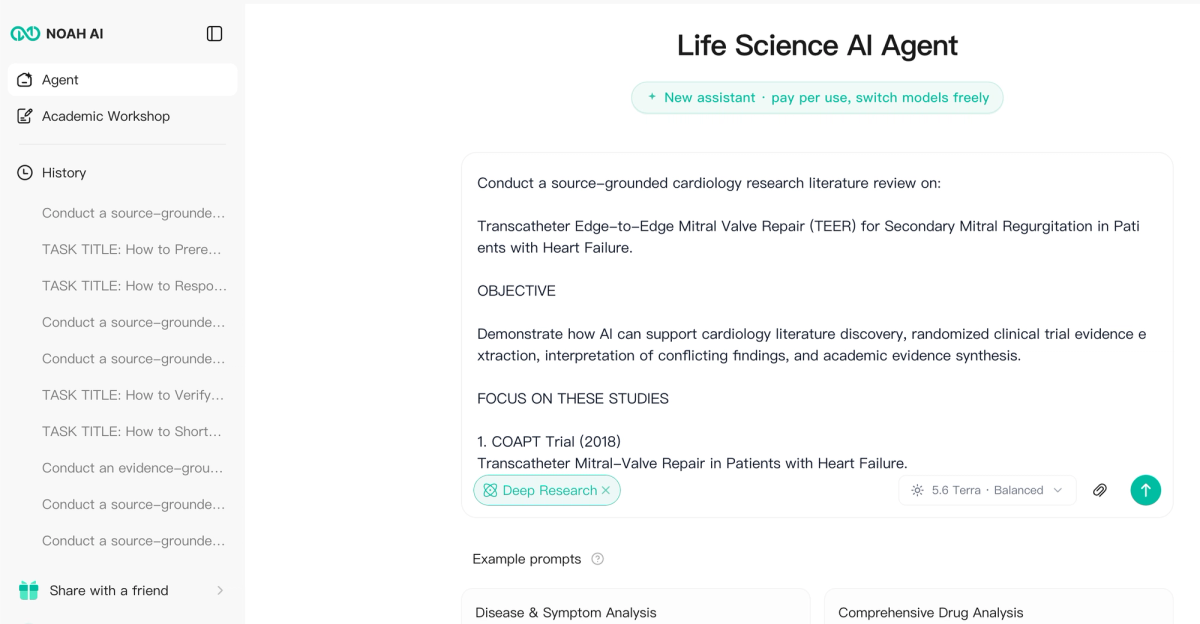
Figure 1. Actual Noah AI Deep Research prompt for the cardiology literature review.
Step 2 — Extract trial evidence without merging endpoints
Noah produced a four-column clinical evidence table with study population, findings, limitations, and PMID/DOI references. The three trial programs should be interpreted individually:
- COAPT: 614 randomized participants. At 24 months, annualized all-HF-hospitalization rates were 35.8% versus 67.9% per patient-year (device plus medical therapy versus control). All-cause death was 29.1% versus 46.1%. Its five-year follow-up reported persistently lower HF hospitalization and all-cause mortality in the intervention group.
- MITRA-FR: 304 randomized participants. At 12 months, the composite of all-cause death or unplanned heart-failure hospitalization occurred in 54.6% versus 51.3%, with no statistically significant difference (P=0.53).
- RESHAPE-HF2: 505 randomized participants. At 24 months, the rate of first or recurrent HF hospitalization or cardiovascular death was 37.0 versus 58.9 events per 100 patient-years (rate ratio 0.64, 95% CI 0.48–0.85). These results support a morbidity/composite-endpoint benefit; they do not alone establish a definitive all-cause mortality benefit.
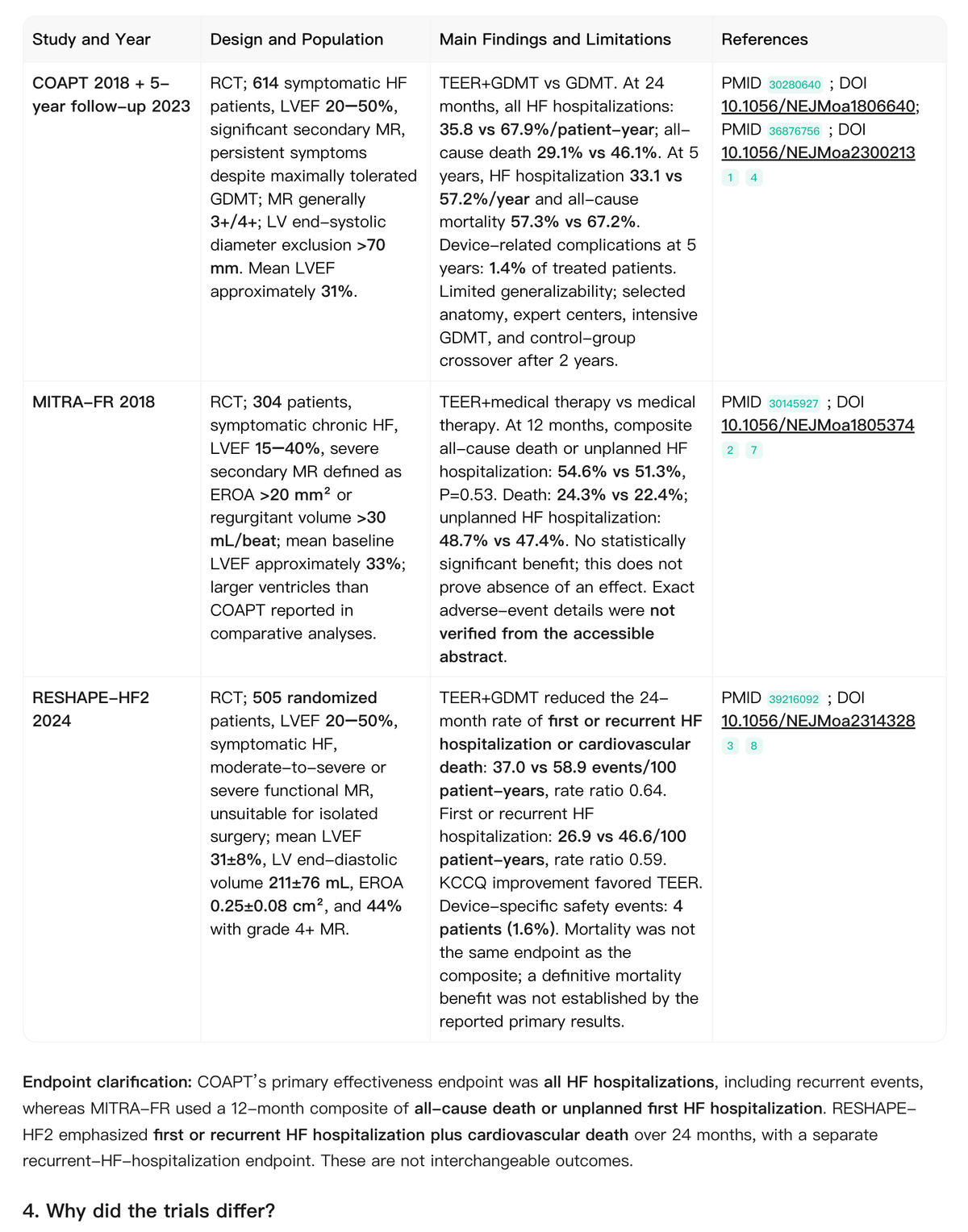
Figure 2. Noah AI's trial evidence table with study designs, outcomes, limitations, and PMID/DOI references. The longer COAPT follow-up is grouped with the original trial.
Why these results should not be directly ranked: COAPT's original endpoint counted all heart-failure hospitalizations; MITRA-FR examined a one-year composite of all-cause death or unplanned hospitalization; RESHAPE-HF2 used a two-year recurrent-event composite including cardiovascular death. Absolute percentages and rate ratios from these different analyses are not interchangeable.
Step 3 — Explain the disagreement, not just the numbers
The narrative analysis from Noah considered patient selection, left ventricular remodeling, MR severity, GDMT, trial design, and endpoint definitions. COAPT found substantial reductions in heart-failure hospitalizations in a carefully selected population. MITRA-FR did not find a statistically significant difference on its prespecified primary composite at 12 months. RESHAPE-HF2 provided additional evidence of reduced recurrent heart-failure events in a different trial population.
Differences in baseline ventricular dimensions and MR severity may help explain why effects appeared different, but such explanations remain hypotheses unless tested directly. A nonsignificant MITRA-FR result is not proof that the intervention has no effect, and a favorable result in another trial does not imply benefit for every patient with secondary MR.
Figure 3. Noah AI's narrative synthesis describing areas of agreement, trial differences, and remaining uncertainty.
What This Example Teaches About Evidence Synthesis
Keep study populations distinct
Cardiology trials often select patients according to different LVEF ranges, ventricular size, echocardiographic thresholds, symptom burden, and background medical therapy. A review that extracts only “TEER improved outcomes” can obscure important eligibility boundaries.
Preserve endpoint definitions
All-cause mortality, cardiovascular death, the risk of first hospitalization, the rate of recurrent hospitalizations, and composite endpoints answer related but different questions. Report the prespecified outcome and follow-up time before interpreting a treatment effect.
Do not double-count follow-up reports
COAPT 2018 and its 2023 five-year publication describe the same randomized trial program at different time points. Treating them as independent RCTs would misrepresent the quantity of evidence.
Separate trial findings from explanatory hypotheses
Differences in MR severity relative to left ventricular dimensions are relevant to trial interpretation. They should be presented as potential explanations, not as established causes of the between-trial differences.
Research Gaps for Future Cardiology Reviews
- Which imaging and functional characteristics best identify patients likely to benefit from TEER?
- How do contemporary GDMT and cardiac resynchronization therapy affect the incremental benefit of TEER?
- When should intervention occur before advanced ventricular remodeling?
- What are the longer-term effects on recurrent hospitalization, quality of life, and mortality?
- How should trials standardize recurrent-event definitions and adjudicate competing risks?
These are questions for further study, not clinical recommendations derived from this one AI-generated report.
Methodology and Limitations of This Comparison
The Noah screenshots are from one actual Deep Research run on TEER literature. The output demonstrates a structured trial table and an interpretive draft, but it is not evidence that Noah has been independently validated for citation accuracy or that it searches all cardiology literature. The other five tools were not run on this case; their descriptions rely on their official documentation.
The clinical example is a focused narrative evidence exercise—not a systematic review or meta-analysis. Important study details should be checked against trial publications, supplementary materials, and current clinical guidelines before use in research, regulatory work, or patient care.
Frequently Asked Questions
Can AI help with cardiology literature reviews?
Yes. AI tools can assist with finding papers, extracting trial characteristics, organizing citations, and drafting summaries. Human review is still needed for study design, eligibility, numerical outcomes, and interpretations.
Which AI tool is most useful for conflicting cardiovascular trials?
The answer depends on the step. Noah AI demonstrated evidence mapping and a trial-focused synthesis in this example; Elicit supports structured study extraction; Scite provides citation context. This article did not conduct a direct performance comparison.
Why did COAPT and MITRA-FR show different results?
The studies differed in enrolled patients, mitral-regurgitation thresholds, ventricular disease, primary endpoints, and follow-up. These differences can inform interpretation but cannot, on their own, prove the cause of divergent results.
Does a reduction in heart-failure hospitalizations prove a mortality benefit?
No. Hospitalizations and mortality are separate outcomes. Benefits for a composite or recurrent-event rate should not be described as a proven all-cause mortality benefit unless the relevant analysis supports that statement.
Can I try Noah AI for free?
Noah AI offers a Basic entry plan. The current signup allowance communicated for this article is 200 credits; available credits are limited, and consumption depends on the task. Deep Research tasks may require additional credits.
Conclusion
The best AI tool for a cardiology literature review depends on the job: locating studies, closely reading papers, tracing citation context, organizing an existing library, or synthesizing trial evidence. For a focused heart-failure research question, the Noah example demonstrates how a structured evidence table can support an explanation of apparent trial disagreements—without flattening different populations and endpoints into a single ranking.
Turn Cardiology Research Questions into Structured Evidence
Go beyond a stack of heart-failure papers. Use Noah AI to investigate biomedical literature, organize clinical trial populations and endpoints, compare reported findings, identify evidence gaps, and develop source-grounded literature review drafts.
Whether you are reviewing TEER trials, heart-failure hospitalization outcomes, or cardiovascular biomarkers, Noah AI can help you build a more traceable research workflow—while keeping the original publications central to verification.
Start exploring with 200 signup credits on the free Basic plan. Credits are limited and usage varies by research task; additional credits may be needed for advanced Deep Research work.
Start Exploring Noah AI for Free — Get 200 Signup Credits
AI-generated research summaries are not independently verified medical guidance. Check the original studies and relevant guidelines before relying on any clinical conclusions.
Research and Product Sources
- COAPT original randomized trial (2018), PMID 30280640
- COAPT five-year follow-up (2023), PMID 36876756
- MITRA-FR randomized trial (2018), PMID 30145927
- RESHAPE-HF2 randomized trial (2024), PMID 39216092
- Noah AI — Literature Review
- Elicit — Research Agent and review workflows
- SciSpace — Literature Review workflow
- Scite — Smart Citations
- Consensus — Medical Mode
- Gemini Notebook — source-grounded chat
Source and product review: November 2026. Features and free allowances may change. Only the Noah workflow shown above was tested for this article.