Best AI Tools for Biomedical Research Question Feasibility Assessment (2026)
Linda
Compare AI tools for biomedical research question feasibility assessment in 2026, with a real Noah AI workflow evaluating novelty, biomarkers, recruitment, endpoints, and study design.
A biomedical research question can sound scientifically interesting and still be a poor study idea.
The literature may already be crowded. The biomarker may not be measured consistently. Recruitment may be too slow. The endpoint may take years to mature. Or the sample size required to answer the question reliably may exceed what the research team can realistically obtain.
That is why feasibility assessment should happen before a team invests months in protocol development, data collection, ethics submissions, or prospective recruitment.
For this guide, we tested Noah AI, a life-science-focused AI Agent, on a real biomedical research question:
Can early circulating tumor DNA (ctDNA) clearance predict pathological response to neoadjuvant chemoimmunotherapy in patients with resectable non-small cell lung cancer?
Instead of asking Noah to write another literature review, we asked a more practical question: Is this research question actually worth pursuing, and if so, how should it be changed before designing the study?
Quick Answer: What Makes a Research Question Feasible?
A strong biomedical question needs more than scientific rationale. It should survive several different feasibility tests.
| Feasibility Question | What It Really Means |
|---|---|
| Is it novel? | Has the question already been answered, or is there still a meaningful knowledge gap? |
| Is it measurable? | Can the biomarker, exposure, and outcome be defined consistently? |
| Is it recruitable? | Can enough eligible participants realistically enter the study? |
| Is it analyzable? | Will there be enough evaluable patients and outcome events for the proposed statistical analysis? |
| Is it operationally realistic? | Can samples, surgery, follow-up, laboratory workflows, and data collection be coordinated reliably? |
| Will the answer matter? | Would the study meaningfully change scientific understanding, future research, or clinical decision-making? |
Our Real Case: Early ctDNA Clearance in Resectable NSCLC
At first glance, the question appears attractive.
ctDNA offers a minimally invasive measure of molecular tumor burden. Neoadjuvant chemoimmunotherapy is now established in resectable NSCLC, and pathological response can be measured at surgery.
That creates an apparently straightforward hypothesis:
If ctDNA disappears early during treatment, will that patient be more likely to achieve major pathological response or pathological complete response?
But a feasibility assessment needs to go further.
It should ask whether the same question has already been studied, whether “early clearance” has a consistent definition, whether baseline-negative patients can be analyzed, whether assay platforms are comparable, how many patients will actually reach surgery, and whether the study would have enough statistical power.
How We Tested the Question in Noah AI
We used Noah's current Agent workflow with:
- Medical & Academia
- Deep Research
- 5.6 Terra · Balanced
Rather than asking whether papers existed, the prompt asked Noah to assess:
- existing evidence density,
- novelty and research gaps,
- population feasibility,
- biomarker feasibility,
- endpoint feasibility,
- data requirements,
- recruitment and operational constraints,
- confounding and bias,
- statistical feasibility,
- ethical implications,
- and competing or ongoing studies.
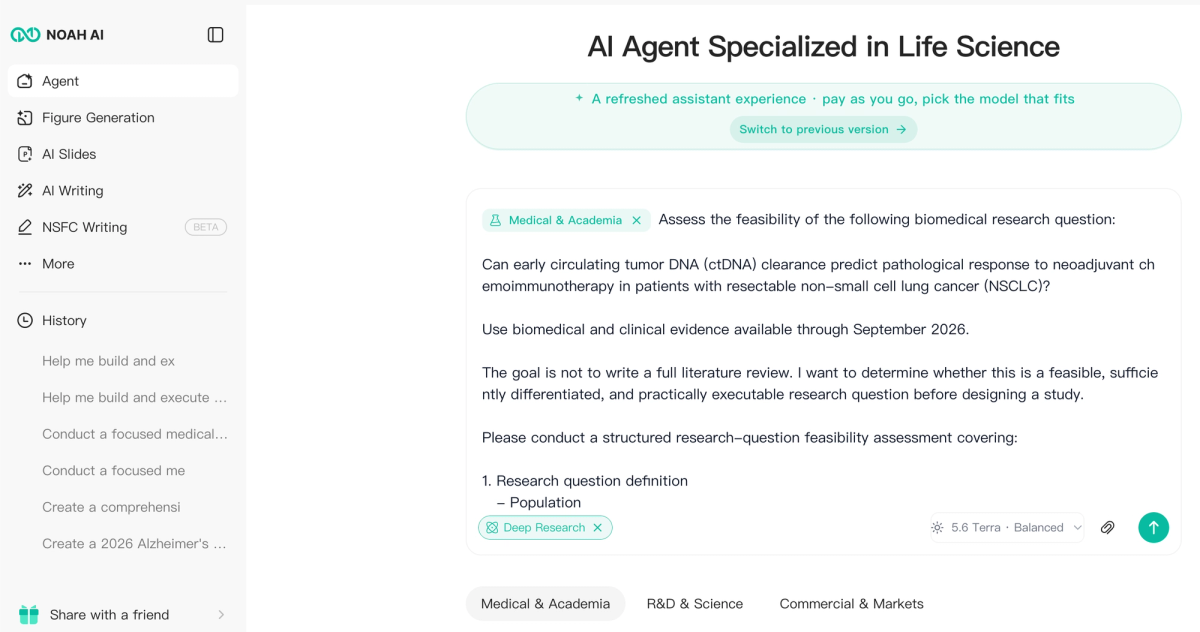
A real biomedical research-question feasibility assessment entered into Noah AI.
The First Important Finding: The Question Is Feasible, but Too Broad
The research question was not rejected.
The evidence supported a strong biological and clinical rationale for studying ctDNA dynamics in neoadjuvant NSCLC. Existing studies also suggest associations between ctDNA clearance, pathological response, and longer-term outcomes.
But that creates a second problem: the broad version of the question is becoming less novel.
A generic study that simply measures perioperative ctDNA and correlates it with response or survival risks repeating work already emerging from prospective cohorts and major perioperative trial biomarker analyses.
The useful research gap is narrower:
Can a prespecified cycle-1 or cycle-2 ctDNA clearance definition, measured with a standardized assay, prospectively predict pathology at resection?
A Feasibility Matrix Is More Useful Than a Simple Yes or No
Noah summarized the research question across multiple feasibility domains rather than collapsing everything into one overall score.
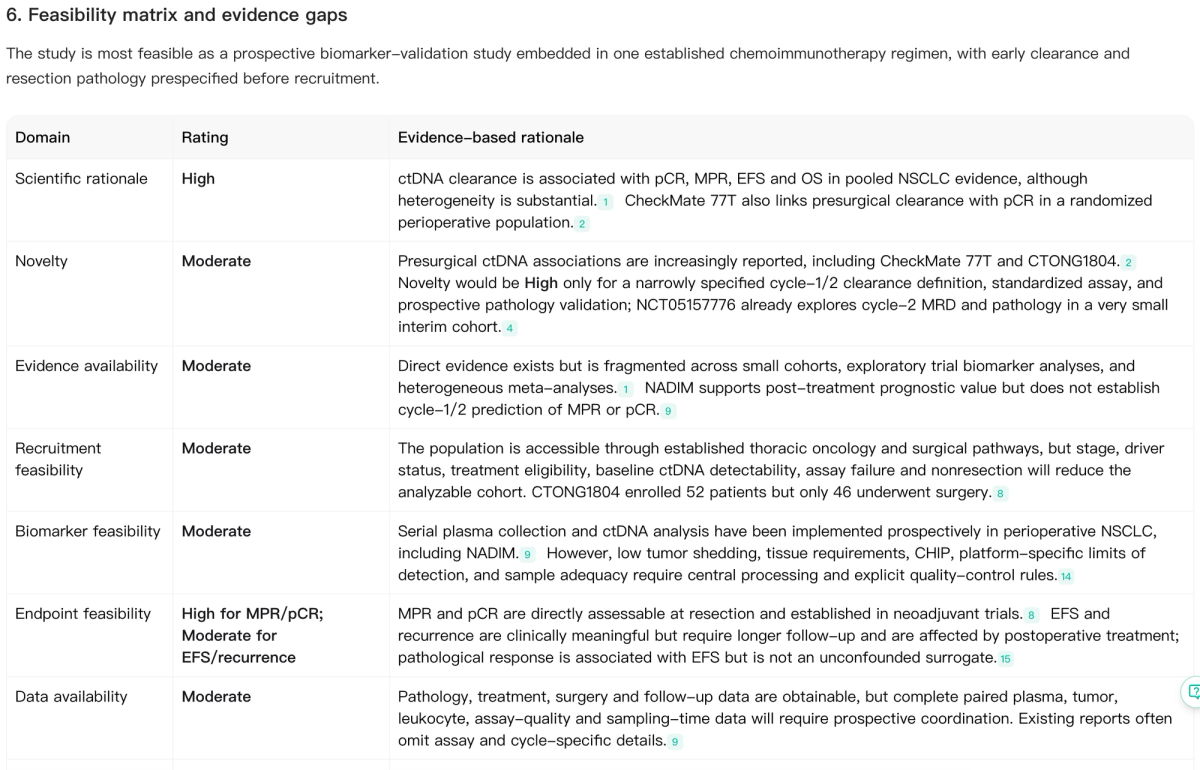
Noah AI evaluates the research question across scientific, biomarker, recruitment, endpoint, and data-feasibility dimensions.
What the Feasibility Matrix Actually Tells Us
| Domain | Assessment | Practical Interpretation |
|---|---|---|
| Scientific rationale | High | ctDNA dynamics are already linked with pathological and survival outcomes, supporting a biologically credible hypothesis. |
| Novelty | Moderate | Generic perioperative ctDNA studies risk redundancy. Novelty improves if timing, assay, population, and endpoint are specified prospectively. |
| Evidence availability | Moderate | Enough evidence exists to design a study, but direct evidence remains fragmented across cohorts and exploratory biomarker analyses. |
| Recruitment feasibility | Moderate | Patients can be identified through established thoracic oncology pathways, but driver status, ctDNA detectability, assay failure, and failure to reach surgery reduce the analyzable population. |
| Biomarker feasibility | Moderate | Serial plasma collection is practical, but assay platform, detection limits, sample quality, tissue requirements, and baseline ctDNA negativity complicate analysis. |
| Endpoint feasibility | High for MPR / pCR | Pathological outcomes are available at surgery and mature much faster than survival endpoints. |
| EFS / recurrence | Moderate | Clinically important, but substantially longer follow-up is required. |
| Data availability | Moderate | Clinical and pathology data are obtainable, but complete serial plasma, tissue, assay-quality, and exact sampling-time data require prospective coordination. |
| Statistical feasibility | Moderate | An MPR-focused prospective validation study is realistic, while detailed subgroup, interaction, and survival analyses require substantially larger cohorts. |
| Operational feasibility | Moderate | Sample timing, tissue sequencing, surgery schedules, transport, processing, and assay turnaround must be tightly controlled. |
Why “High Scientific Rationale” Does Not Mean “Start the Study”
This is one of the most useful distinctions in feasibility assessment.
A question can have excellent biological rationale while still being poorly designed.
In this example, scientific rationale was strong, but novelty, recruitment, biomarker implementation, data completeness, and statistics were only moderately feasible.
That points toward a Modify decision rather than an automatic Go.
Biomarker Feasibility Can Break an Otherwise Good Study
“ctDNA clearance” sounds like a simple binary variable:
detectable → undetectable
In practice, the definition depends on:
- the assay platform,
- limit of detection,
- plasma volume,
- sample quality,
- sequencing depth,
- tumor-informed versus plasma-only methodology,
- sampling time,
- and how technically uninformative samples are handled.
Baseline-negative patients create another problem: they cannot technically demonstrate “clearance.”
A protocol therefore needs separate categories for:
- baseline detectable → cleared,
- baseline detectable → persistent,
- baseline negative,
- and technically uninformative.
Endpoint Choice Changes the Entire Feasibility Calculation
The same research question can move from feasible to impractical depending on the primary endpoint.
| Endpoint | Feasibility | Main Consideration |
|---|---|---|
| MPR | High | Available at surgery and more frequent than pCR, making biomarker validation statistically easier. |
| pCR | High to Moderate | Clinically clear and available at surgery, but lower event frequency increases sample-size requirements. |
| Postoperative MRD | Moderate | Useful secondary molecular endpoint but requires another carefully timed sample. |
| EFS | Moderate | Clinically stronger but requires longer follow-up and is affected by postoperative treatment. |
| OS | Low for an initial validation study | Requires long follow-up and substantially more events. |
Check Whether Another Study Is Already Closing the Gap
Feasibility assessment should include the competitive research landscape, not just published papers.
In this case, existing perioperative NSCLC studies already contain ctDNA analyses, while ongoing prospective work is beginning to examine early molecular response and pathological outcomes.
This matters because a question that looks novel based on PubMed alone may already be under prospective investigation.
Before starting a study, researchers should therefore check:
- PubMed,
- ClinicalTrials.gov,
- major conference abstracts,
- recent trial biomarker analyses,
- and relevant guideline or consensus documents.
The Most Useful Output: Proceed, Modify, or Stop?
A feasibility tool should not automatically tell researchers that every proposed project is a good idea.
For this case, Noah's final recommendation was:
Proceed, but narrow or modify the question.
The broad question was scientifically credible, but a generic study correlating perioperative ctDNA with response or survival would risk redundancy.
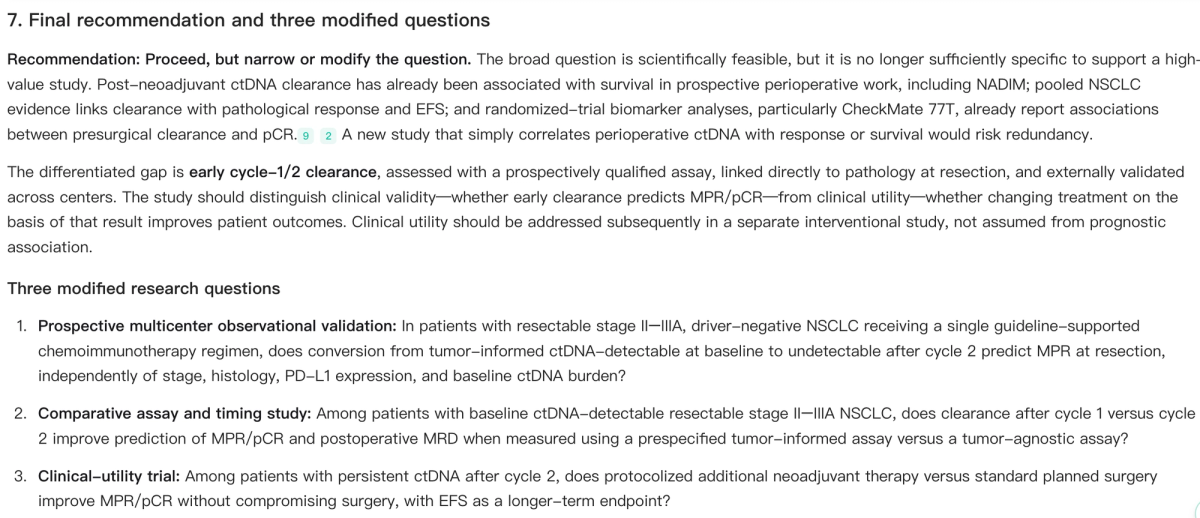
Noah AI moves from feasibility assessment to a specific Proceed-but-Modify recommendation and proposes three narrower research questions.
Free to use · Free credits included · No credit card required
Assess Biomedical Research Feasibility with Noah AI →
How the Original Question Can Be Improved
The strongest near-term direction is not:
Does ctDNA predict response in resectable NSCLC?
A more differentiated question would specify:
- a defined stage population,
- one treatment regimen,
- one assay approach,
- a prespecified cycle-1 or cycle-2 blood draw,
- a locked clearance definition,
- and MPR or pCR at surgery as the validation endpoint.
Modified Question 1: Prospective Validation
In patients with resectable stage II–IIIA, driver-negative NSCLC receiving one defined chemoimmunotherapy regimen, does conversion from baseline ctDNA-detectable to undetectable after cycle 2 independently predict MPR?
Modified Question 2: Timing and Assay Comparison
Does clearance after cycle 1 versus cycle 2 improve prediction of MPR or pCR, and does performance differ between prespecified tumor-informed and tumor-agnostic assay approaches?
Modified Question 3: Clinical Utility
Among patients with persistent ctDNA after cycle 2, does changing neoadjuvant management improve pathological response without compromising surgery?
This third question is much more demanding because it moves from biomarker validation to biomarker-guided treatment intervention.
Clinical Validity and Clinical Utility Are Not the Same
This distinction is especially important in biomarker research.
A study can demonstrate that ctDNA clearance predicts pathology without proving that physicians should change treatment based on the result.
Those are two separate questions:
| Question | What It Tests |
|---|---|
| Clinical validity | Does the biomarker reliably predict or associate with a clinically relevant outcome? |
| Clinical utility | Does changing management based on the biomarker improve patient outcomes? |
The second question normally requires a substantially more demanding interventional design.
Best AI Tools for Different Parts of Feasibility Assessment
| Tool | Best Role in Feasibility Assessment |
|---|---|
| Noah AI | Biomedical question → evidence landscape → feasibility matrix → research gap → modified study question. |
| PubMed | Verify whether the research question is already well represented in peer-reviewed biomedical literature. |
| ClinicalTrials.gov | Check whether competing or overlapping prospective studies are already underway. |
| Elicit | Useful for structured evidence discovery, protocol refinement, screening, and extraction across the literature set. |
| Consensus | Useful for rapidly understanding the existing academic consensus, counterpoints, and potential evidence gaps around a question. |
| SciSpace | Useful for inspecting individual papers, methods, inclusion criteria, assay details, and full-text evidence. |
| Scite | Useful for checking how later literature supports, contrasts with, or contextualizes important studies. |
| ChatGPT Deep Research | Useful for broader feasibility work that combines publications, trial registries, regulatory information, websites, and uploaded project documents. |
Red Flags That Mean You Should Not Start the Study Yet
A feasibility assessment should actively look for reasons not to proceed.
- The research question is still too broad.
- The same study is already underway elsewhere.
- The proposed biomarker has no stable operational definition.
- The primary endpoint will not mature within a realistic project timeline.
- The eligible population is much smaller than expected.
- A large proportion of patients will be biomarker-uninformative.
- Critical confounders cannot be collected reliably.
- The intended subgroup analyses will be underpowered.
- Required serial biospecimens are unavailable.
- The study requires changing treatment before clinical utility is established.
A Practical Go / Modify / No-Go Framework
| Decision | When It Makes Sense |
|---|---|
| GO | Clear knowledge gap, measurable variables, realistic recruitment, adequate sample size, feasible follow-up, and meaningful expected contribution. |
| MODIFY | Strong rationale exists, but the question is too broad, partially redundant, operationally difficult, or statistically inefficient. |
| NO-GO | The question has already been answered, required data are unavailable, recruitment is unrealistic, endpoints cannot mature, or the proposed design cannot answer the stated question. |
Our ctDNA case falls in the middle: Modify.
Frequently Asked Questions
What is research question feasibility assessment?
Research question feasibility assessment evaluates whether a proposed study is scientifically differentiated, measurable, recruitable, statistically analyzable, operationally executable, and likely to produce a meaningful answer before formal study design begins.
Is a research gap enough to justify a new study?
No. A gap may exist but still be impractical to study. Researchers also need adequate data, participants, endpoints, measurement tools, statistical power, time, and operational capacity.
How can AI help assess research novelty?
AI can help map published evidence, identify related clinical trials, compare existing research questions, and highlight areas where definitions, populations, endpoints, or validation remain inconsistent.
Can AI tell me whether my study is sufficiently powered?
AI can identify the variables that drive sample-size requirements and support early feasibility planning. A formal study still requires a prespecified statistical power calculation using defensible assumptions.
Why should ClinicalTrials.gov be checked during feasibility assessment?
A study can appear novel in published literature while another team is already running a closely related prospective trial. Registry review therefore matters when assessing the remaining novelty window.
Should a feasibility assessment always recommend proceeding?
No. A useful assessment should be capable of recommending Go, Modify, or No-Go depending on the evidence and practical constraints.
Final Takeaway
The purpose of biomedical research feasibility assessment is not to prove that an interesting idea is good.
It is to discover the weaknesses of the idea before those weaknesses become an expensive study.
In our real NSCLC case, the broad question had a strong scientific rationale, but the novelty window was already narrowing and several operational and biomarker constraints remained.
Noah AI therefore did not simply return “yes.” It moved the question from:
Can early ctDNA clearance predict pathological response?
toward a much more study-ready version:
In a defined stage II–IIIA population receiving one standardized regimen, does assay-qualified ctDNA clearance at a prespecified early treatment time point independently predict MPR at resection?
That is the value of feasibility research: not just finding evidence, but deciding whether the next study should be run at all—and what question it should actually answer.
Assess Biomedical Research Feasibility with Noah AI
Use Noah AI to evaluate whether a biomedical research question is supported by sufficient literature, clinical evidence, biomarkers, patient populations, and ongoing research activity before investing in a deeper study.
Free to use · Free credits included · No credit card required
Assess Biomedical Research Feasibility with Noah AI →
Selected Evidence From This Case
- Circulating Tumor DNA Is Associated With Pathologic Response and Survival Outcomes in NSCLC Treated With Neoadjuvant Immunotherapy
- Biomarkers of Nivolumab Benefit in Resectable Non-Small Cell Lung Cancer
- NADIM Phase II — Overall Survival and Biomarker Analysis
- CTONG1804 — Neoadjuvant Nivolumab With or Without Platinum-Doublet Chemotherapy
- NCT05594381 — Biomarker Study in Resectable NSCLC