Best AI Tools for Biomedical Research Proposal Development (2026)
Linda
Compare AI tools for biomedical research proposal development in 2026, with a real Noah AI workflow turning a research question into hypotheses, specific aims, study design, endpoints, and methods.
A biomedical research proposal is not simply a longer literature review.
Once a research question appears scientifically worthwhile, the next challenge is turning it into a study that can actually be conducted: a clear hypothesis, measurable aims, a realistic population, defined biomarkers and endpoints, an analysis plan, and a defensible study design.
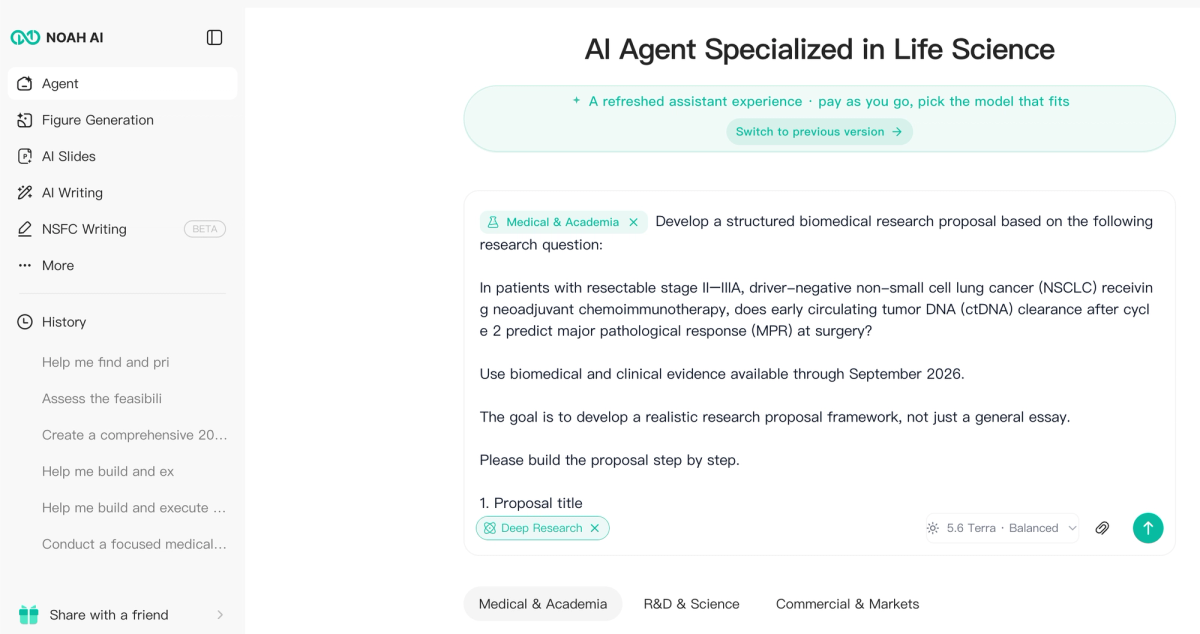
For this guide, we tested Noah AI on a real proposal-development workflow. Rather than asking it to “write a research proposal,” we started with a narrowly defined biomedical question:
In patients with resectable stage II–IIIA, driver-negative NSCLC receiving neoadjuvant chemoimmunotherapy, does early circulating tumor DNA (ctDNA) clearance after cycle 2 predict major pathological response (MPR) at surgery?
We then asked Noah to develop the question step by step into a structured biomedical research proposal.
Quick Answer
The most useful AI tools for proposal development do more than generate prose. They help researchers move from evidence gap → hypothesis → specific aims → study design → endpoints → methods → analysis → proposal draft.
What Should AI Actually Help With in a Research Proposal?
| Proposal Task | Useful AI Role |
|---|---|
| Research gap | Map what is known and identify a defensible unresolved question. |
| Hypothesis | Turn the gap into a specific and testable claim. |
| Specific aims | Separate primary and secondary objectives. |
| Study design | Compare prospective, retrospective, observational, and interventional options. |
| Endpoints | Align measurable outcomes with the research aims. |
| Analysis | Identify confounders, missing-data issues, and statistical requirements. |
Step 1: Start With a Specific Research Question
Weak proposal prompts often begin with something broad:
Write a research proposal about ctDNA and lung cancer.
That leaves the AI to invent the population, treatment setting, timing, biomarker definition, endpoints, and even the study objective.
Instead, the question should already identify the core population, exposure or biomarker, clinical setting, and outcome.
Step 2: Define the Research Gap Before Writing the Proposal
A good proposal does not simply argue that a topic is important. It explains exactly what previous studies have not answered.
In this example, the broad question of whether ctDNA is associated with outcome in resectable NSCLC is no longer sufficiently differentiated.
The more specific gap is whether a prespecified cycle-2 ctDNA assessment can predict pathological response before surgery in a standardized neoadjuvant chemoimmunotherapy population.
Step 3: Turn the Gap Into a Testable Hypothesis
The hypothesis should be measurable and should not make a stronger causal claim than the study design can support.
In this case, Noah framed the proposal as an observational predictive-association study:
Among patients with resectable stage II–IIIA, driver-negative NSCLC receiving neoadjuvant platinum-doublet chemoimmunotherapy, clearance of tumor-informed ctDNA from baseline to a prespecified sample after cycle 2 is associated with a higher probability of MPR at surgery.
Step 4: Build Specific Aims Around the Hypothesis
Specific aims are where a research proposal begins to become operational. Each aim should correspond to an analysis the study can realistically perform.
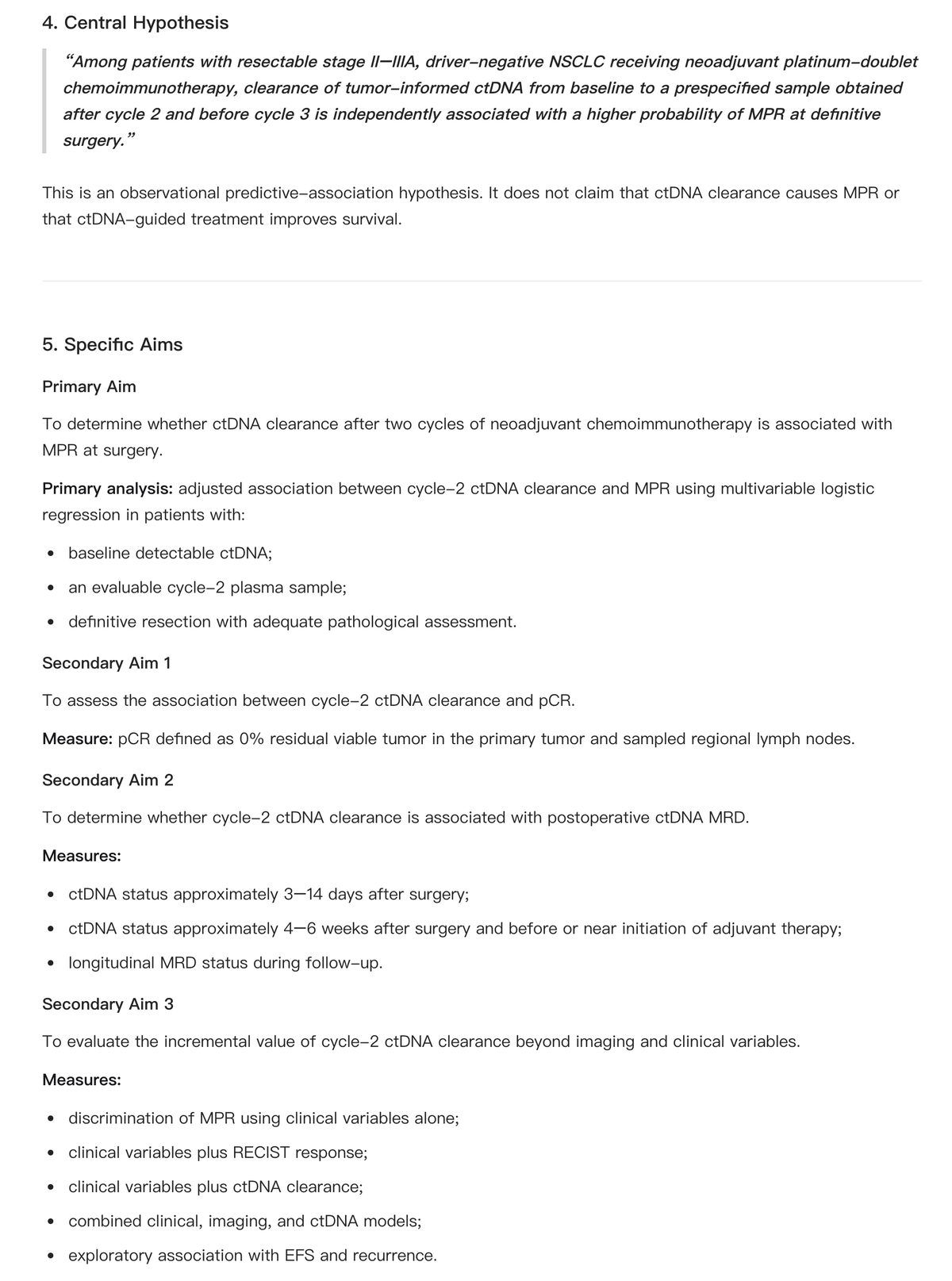
The primary aim asks whether cycle-2 ctDNA clearance is associated with MPR. Secondary aims then extend the proposal without changing its central research question.
| Aim | Question |
|---|---|
| Primary | Is cycle-2 ctDNA clearance associated with MPR at surgery? |
| Secondary 1 | Is cycle-2 clearance associated with pathological complete response? |
| Secondary 2 | Is cycle-2 clearance associated with postoperative ctDNA MRD? |
| Secondary 3 | Does ctDNA add predictive value beyond imaging and standard clinical variables? |
Step 5: Choose the Study Design
The next step is deciding what type of study can actually answer the aims.
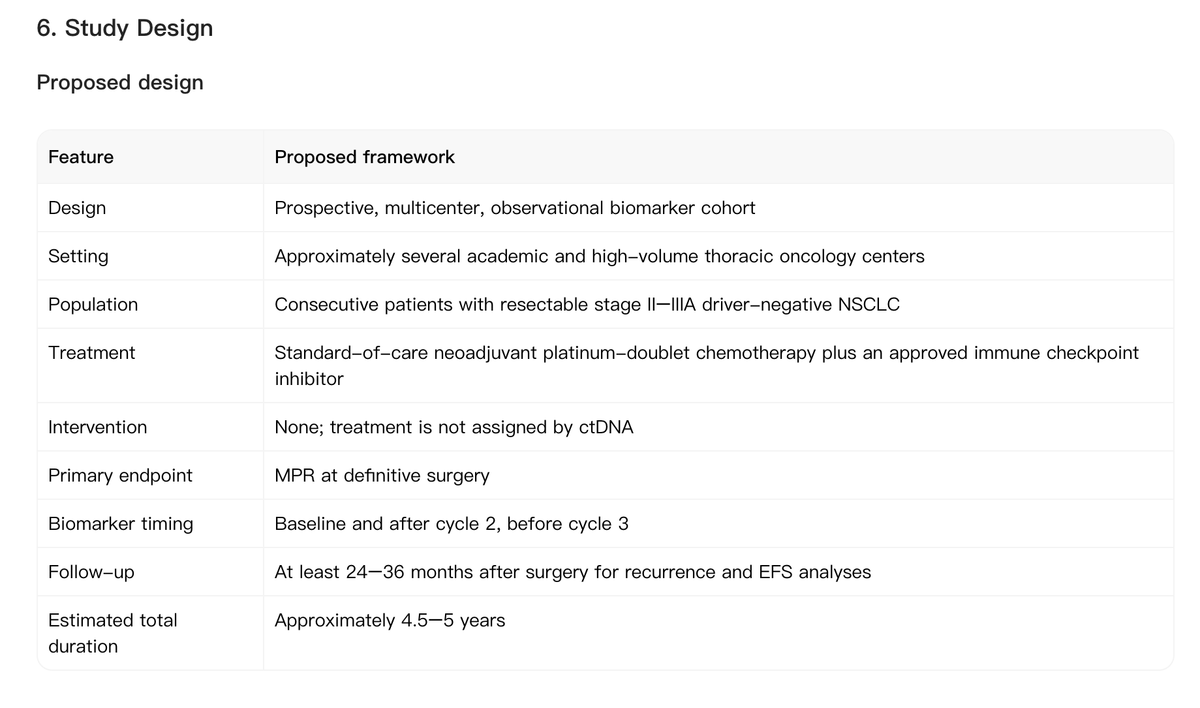
For this case, Noah proposed a prospective, multicenter, observational biomarker cohort.
That choice matters. The study is intended to validate whether early ctDNA clearance predicts pathology; it is not yet designed to change treatment according to the ctDNA result.
Free to use · Free credits included · No credit card required
Develop a Research Proposal with Noah AI →
Step 6: Define the Study Population Precisely
A proposal becomes difficult to interpret when the target population remains vague.
In this example, the population is restricted to:
- adults with resectable NSCLC,
- stage II–IIIA disease,
- driver-negative tumors,
- planned neoadjuvant platinum-doublet chemoimmunotherapy,
- and planned definitive surgery.
Step 7: Prespecify the Biomarker Strategy
Biomarker studies are particularly vulnerable to definitions being changed after the results are known.
The proposal therefore needs to define the ctDNA collection points before recruitment.
| Time Point | Purpose |
|---|---|
| Baseline | Establish whether ctDNA is detectable before treatment. |
| After cycle 2 | Primary early-response biomarker time point. |
| After surgery | Assess postoperative molecular residual disease. |
| Follow-up | Explore molecular recurrence before radiographic progression. |
Step 8: Match the Endpoint to the Research Timeline
A clinically important endpoint is not automatically a practical primary endpoint.
| Endpoint | Role | Practical Issue |
|---|---|---|
| MPR | Primary | Available at surgery. |
| pCR | Secondary | Clear endpoint but less frequent. |
| MRD | Secondary | Requires standardized postoperative sampling. |
| EFS | Exploratory / secondary | Requires substantially longer follow-up. |
Step 9: Build the Statistical Plan Before Choosing a Sample Size
One place where AI-generated proposals frequently become unreliable is sample size.
A model should not invent a number such as “120 patients” without specifying the assumptions behind it.
A formal calculation would first require estimates for:
- baseline ctDNA detectability,
- cycle-2 clearance rate,
- MPR prevalence,
- expected effect size,
- paired-sample availability,
- surgery completion rate,
- assay failure,
- and the number of adjustment variables.
Step 10: Identify Bias Before Data Collection
Proposal development should identify predictable sources of bias before recruitment begins.
- Selection bias: not every treated patient will proceed to surgery.
- Measurement bias: ctDNA results depend on assay sensitivity and sample handling.
- Treatment heterogeneity: different regimens may affect biomarker kinetics.
- Surgical-selection bias: MPR is only measurable in resected patients.
- Missing biospecimens: patients without paired samples may differ systematically.
Step 11: Separate Biomarker Validation From Clinical Utility
This distinction is particularly important in clinical biomarker proposals.
Demonstrating that ctDNA predicts MPR does not prove that changing treatment according to ctDNA will improve patient outcomes.
| Question | Study Type |
|---|---|
| Does cycle-2 ctDNA clearance predict MPR? | Prospective observational validation |
| Does changing treatment based on ctDNA improve outcome? | Biomarker-guided interventional trial |
Step 12: Turn the Framework Into a Proposal Draft
Only after the evidence gap, hypothesis, aims, design, endpoints, biomarker timing, analysis framework, and risks have been defined should the AI generate the full proposal.
A useful final structure may include:
Title and abstract
Scientific premise
Background
Research gap
Central hypothesis
Specific aims
Study design
Eligibility criteria
Biomarker and biospecimen plan
Endpoints
Statistical analysis
Bias and limitations
Ethical considerations
Timeline
Risk mitigation
Expected impact
Best AI Tools for Different Parts of Biomedical Proposal Development
| Tool | Best Use |
|---|---|
| Noah AI | Biomedical evidence → research gap → aims → study design → structured proposal. |
| PubMed | Verify primary biomedical evidence supporting the proposal. |
| ClinicalTrials.gov | Check whether similar studies are already underway. |
| Elicit | Structured literature discovery and evidence extraction. |
| SciSpace | Deep reading of methods, protocols, and study details. |
| Scite | Check citation context around important proposal claims. |
| Zotero | Reference organization and citation management. |
What AI Should Not Decide for You
- A precise sample size without defensible assumptions.
- Whether an observational association proves clinical utility.
- Final ethical acceptability of an intervention.
- Whether every proposed endpoint is clinically meaningful.
- Final inclusion and exclusion criteria without expert review.
- Whether an AI-generated citation or trial result is correct without verification.
Final Takeaway
The value of AI in research proposal development is not simply faster writing.
The more useful workflow is:
evidence → gap → hypothesis → aims → design → endpoints → methods → analysis → proposal
In our Noah AI example, a single biomedical question was transformed into a testable hypothesis, multiple measurable aims, and a prospective multicenter observational study framework rather than an unsupported generic proposal.
That distinction matters: a good research proposal should explain not only what you want to study, but why the question remains unanswered and how the proposed study can answer it.
Turn a Biomedical Research Question Into a Structured Proposal
Use Noah AI to move from evidence and research gaps to research aims, study design, endpoints, methods, and a structured proposal framework.
Free to use · Free credits included · No credit card required