How to Audit STROBE Reporting Gaps in Observational Medical Studies with AI (2026)
Linda
Learn how to audit STROBE reporting gaps in observational medical studies with AI. Review cohort study methods, bias, missing data, and evidence using a real paper.
A practical, source-grounded workflow for mapping an observational study to the STROBE checklist, finding reporting details that need clarification, and creating an evidence-linked reporting gap table with Noah AI.Clinical and epidemiological research · Step-by-step guide · Real cohort-study example
Key Takeaways
- STROBE is a reporting guideline, not a study-quality score. Its 22 numbered items help authors explain how an observational study was conducted and reported.
- Map each judgment to original evidence. A useful audit records the exact Methods, Results, figure, table, or supplementary-material location.
- Distinguish missing reporting from inaccessible information. “Partial” and “not verified” should not automatically mean that a study was methodologically flawed.
- Use AI to organize a review, not certify compliance. Noah can assist with source-based comparison; researchers must validate every flagged item.
What Are CONSORT, STROBE, and PRISMA—and Which Checklist Fits?
Reporting guidelines address different study designs. CONSORT concerns randomized trials; PRISMA concerns systematic reviews and meta-analyses; STROBE focuses on observational studies. For the present walkthrough, the correct document is the STROBE checklist for cohort studies, not a generic mixture of all three frameworks.STROBE contains 22 numbered items, some with subparts. Its scope spans the title and abstract, background, Methods, Results, Discussion, and funding. Requirements include how participants were selected (Item 6), how bias was addressed (Item 9), why the study size was chosen (Item 10), how missing data were handled (Item 12c), how results and missing baseline data were presented (Items 13–16), and whether funding roles were disclosed (Item 22).
| Guideline | Study type | Main reporting emphasis |
|---|---|---|
| CONSORT | Randomized clinical trials | Allocation, randomization, intervention, participant flow and outcomes |
| STROBE | Cohort, case-control and cross-sectional studies | Selection, measurement, confounding, bias, statistical reporting and limitations |
| PRISMA | Systematic reviews | Literature searches, selection, evidence synthesis and transparent review reporting |
Use the official design-specific checklist. A cross-sectional study, for example, should not inherit every cohort-specific follow-up recommendation.
Introduction: Why Checklist-Aware Reporting Matters
Observational medical research frequently has complex exposure definitions, evolving follow-up, multiple adjustment models, missing covariates, and sensitivity analyses. A manuscript can give a plausible summary of these choices while leaving a reader unsure exactly how one analysis was performed. STROBE asks researchers to make those details visible.That distinction is especially important with AI-assisted writing and review. A fluent summary is not the same as an auditable report. An AI system may identify a familiar statistical term, yet overlook whether the paper reports the analysis population, how missing observations were handled, or where a sensitivity analysis is documented.The objective of a useful AI workflow is therefore narrower than “automatic STROBE compliance.” It is to connect a specific reporting recommendation with a verifiable source location, then decide whether a human reviewer needs more information.
Key Challenges in Auditing Observational Studies
- Reporting details are spread across a paper
Participant eligibility may appear in Methods, the actual sample-flow counts in Figure 1, and sensitivity analyses in supplementary appendices. A check restricted to the abstract will generate false missing-item flags. The same problem arises when a report refers to an appendix that has not actually been retrieved.
- Reporting completeness and risk of bias are not identical
STROBE Item 9 asks authors to describe efforts to address potential bias. A paper can meet that reporting requirement while residual confounding still exists. Conversely, a reporting detail that is hard to locate does not automatically prove a statistical method was absent from the research.
- Several items require exact, not generic, statements
For Item 10, simply stating the final sample size may not fully explain how that sample size was determined. For Item 14b, reporting some missing-data percentages may not be equivalent to indicating missingness for each relevant variable. For Item 19, naming a limitation is not always the same as discussing its possible direction and magnitude.
- AI can misclassify nuanced methods
Missing-data handling is a common example. A manuscript may use simple imputation in the primary model and multiple imputation only in sensitivity analyses. Conflating those analyses can produce a misleading description even when the overall item status is reasonable.
How Noah AI Can Support STROBE Reporting Review
For this demonstration, a question was prepared in Noah AI asking it to assess a real cohort study against the official STROBE checklist. The task specifies the publication, the checklist version, the required status categories, and evidence-location columns. The actual research output was then organized into a compact reporting-gap table.
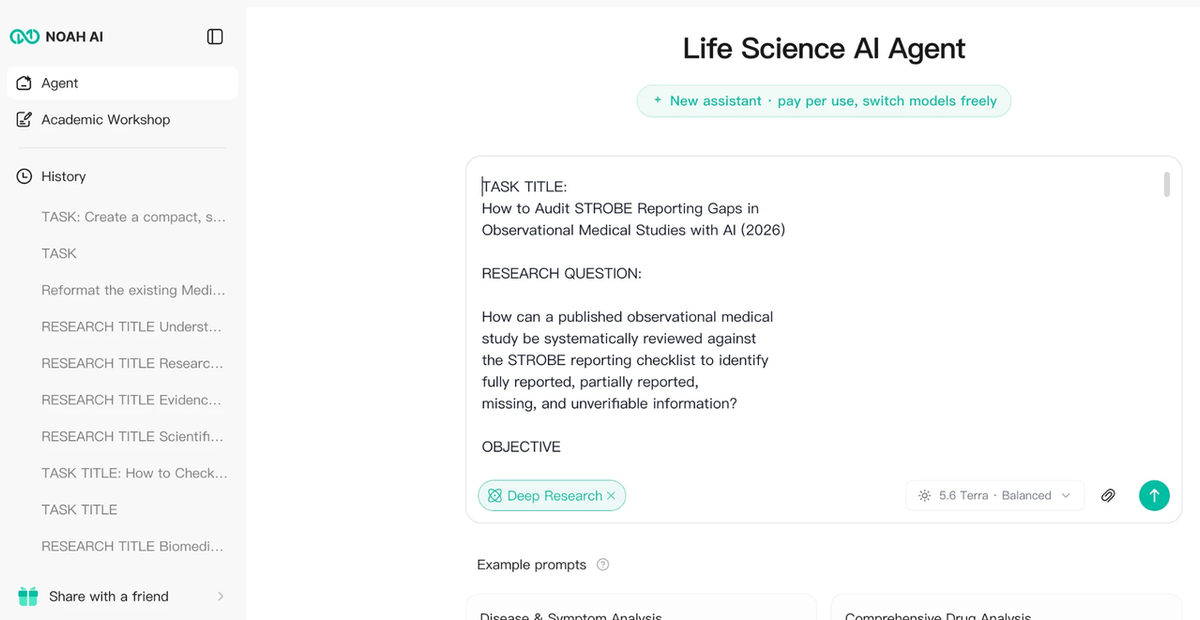
Noah's role here is evidence organization: mapping a guideline item to a paper section, collecting a candidate status, and making the remaining questions visible. The screenshot is not evidence of an integrated STROBE certification tool, a guaranteed exhaustive supplement search, or automated journal approval.
Review biomedical evidence with Noah AI
Use a source-grounded research prompt to organize reporting requirements, paper sections, and questions for expert review. Start with available free credits.Try Noah AI for Free — Free Credits Available
Step-by-Step Workflow: From STROBE Item to Reporting Gap
Step 1. Choose the correct STROBE checklist
Confirm whether the paper is a cohort, case-control, or cross-sectional study. Keep the official item numbers and subitems intact. In a cohort study, for example, Item 12c concerns missing data, while Item 12b concerns subgroup and interaction analyses. Item 13a deals with numbers at study stages; Item 13c asks authors to consider a flow diagram.
Step 2. Identify the original paper and source materials
Provide the exact paper title, DOI or PMID, full-text link, and accessible supplementary appendices. Ask Noah to declare whether it read the abstract, full article, tables, figures, and supplements. Mark an item not verified when the needed source cannot be inspected rather than assuming it is missing.
Step 3. Request an item-by-item evidence mapping
For every applicable STROBE item, request: the reporting requirement, status, supporting text or section location, and any clarification needed. Use consistent labels such as MET, PARTIAL, MISSING, NOT VERIFIED, and NOT APPLICABLE. Avoid creating a single numerical “quality score.”
Step 4. Check important judgments against the paper
Open the cited sections. Verify participant flow and exclusions against Figure 1; read statistical methods for missing-data handling; check Table 1 for baseline missingness; and review the Discussion for limitations. If the AI's summary omits a methodological distinction, correct the interpretation without changing the original screenshot.
Step 5. Turn genuine uncertainties into editorial actions
Each unresolved item should end in a practical question: “Where is the original study-size rationale?”, “Which baseline covariates have missing values?”, or “Does a supplement contain the full table?” A recommendation should never invent a missing statistic, analysis method, or funding declaration.
Example Use Case: Auditing a Real Prospective Cohort Study
The worked example uses Ultra-processed food intake and risk of cardiovascular disease: prospective cohort study (NutriNet-Santé) by Srour and colleagues, published in The BMJ (DOI: 10.1136/bmj.l1451; PMID: 31142457).The French cohort analysis included 105,159 adults and reported 1,409 incident cardiovascular disease events during a median 5.2 years of follow-up. The authors estimated an adjusted hazard ratio of 1.12 (95% CI 1.05–1.20) per absolute ten-percentage-point increase in the proportion of ultra-processed food in the diet. That is an observational association, not proof of causation.Noah's full working report mapped all 22 numbered STROBE items and relevant subitems. For a legible screenshot, the resulting compact table highlights eight priority items rather than presenting itself as a complete 22-item audit.
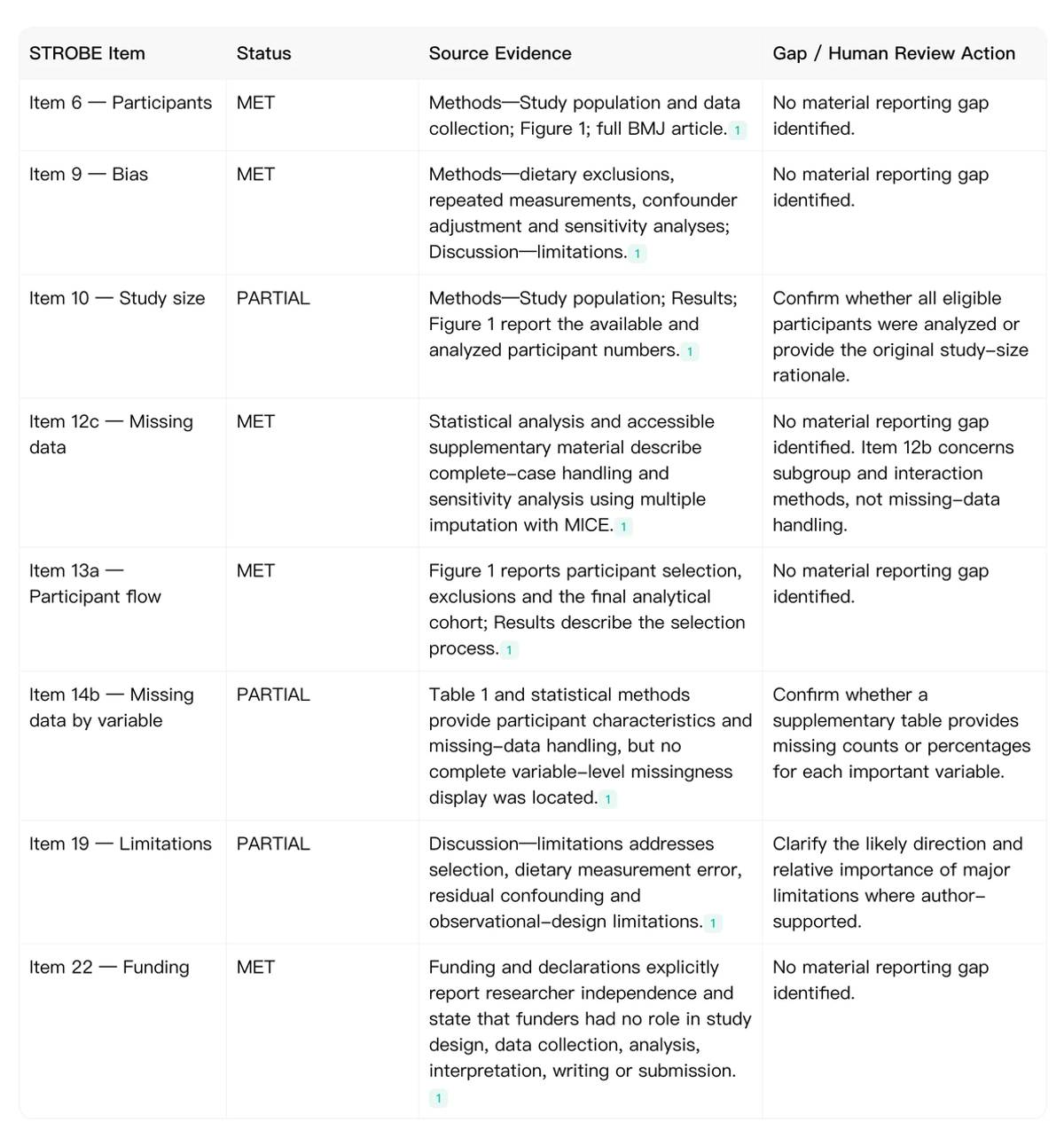
Source-check clarification for Item 12c: The screenshot summarizes complete-case and MICE analyses, but the original paper additionally explains that the primary analysis used median/mode imputation for most covariates and a missing category for physical activity; complete-case and 20-dataset MICE analyses were sensitivity checks. This distinction matters when summarizing the original methods. See the article's Statistical Analysis section.
What the eight-row audit actually found
In this selected subset, Noah classified participants (Item 6), bias-reporting efforts (Item 9), missing-data methods (Item 12c), participant numbers (Item 13a), and funding (Item 22) as MET. The original article indeed reports a participant flow figure and an explicit statement that its funders did not influence design, data collection, analysis, interpretation, writing, or submission.Three items were flagged as PARTIAL in the compact output:
- Item 10 — Study size: whether the authors clearly explain why the analytic sample contains the reported number, rather than merely stating the final count.
- Item 14b — Missing data by variable: whether a complete variable-level missingness display is available. The original Methods already gives examples including education (5.0%), physical activity (13.9%), and body mass index (0.6%); a “partial” flag is a request to examine the remaining variable-level reporting, not evidence that no missingness was reported.
- Item 19 — Limitations: whether the likely direction and magnitude of major limitations are characterized sufficiently. The published Discussion already discusses selection, dietary measurement and residual confounding, so this is an editorial question, not a finding that limitations are absent.
A responsible interpretation is therefore “generally detailed reporting, with targeted points requiring confirmation”. It would be incorrect to say that this demonstration proved the BMJ paper noncompliant, invalid, or causally misleading. Additional appendices should be inspected before making definitive claims that a detail is not reported anywhere.
How to Use Noah AI for Checklist-Aware Research Review
Start a research task in Noah Agent and enter the study's exact citation and the STROBE cohort checklist URL. Ask for a 22-item audit with numbered subitems, then request a compact four-column table for the strongest examples. The output columns used in this demonstration were STROBE Item · Status · Source Evidence · Gap / Human Review Action.Reusable prompt: “Review the linked cohort study against the official STROBE 22-item cohort checklist. For each applicable item, return the exact reporting location, a provisional MET/PARTIAL/MISSING/NOT VERIFIED status, and a human verification action. Do not invent gaps; distinguish material found in supplements from missing information. Then summarize eight high-priority items in a four-column Reporting Gap Table.”Review the result one item at a time. When the table contains a questionable sentence, follow the paper link and reconcile it before publication. If an output was built from supplied notes instead of independent retrieval, say so; do not present a formatted table as an independently repeated search.
Final STROBE Reporting Audit Checklist
- Identify the correct observational design and official STROBE checklist.
- Verify title, DOI/PMID, version of record, tables, figures and supplements.
- Use the original item numbers and retain applicable subitems.
- Require a source section, figure, table, or supplement reference for every status.
- Distinguish missing information from inaccessible source material.
- Separate sample-size explanation, participant flow and follow-up attrition.
- Check missing-data treatment in the primary model and sensitivity analyses.
- Inspect missingness by variable and read the complete funding disclosure.
- Describe PARTIAL flags as issues for human review, not confirmed design failures.
- Document corrections, reviewer decisions, and any remaining unknowns.
Conclusion & Next Steps
STROBE-aware AI review can make observational manuscripts easier to audit by connecting each reporting recommendation with evidence found in the paper. The NutriNet-Santé example shows why a useful output includes both items judged fully reported and items that merit further clarification. It also shows why checking the original statistical Methods can improve an AI-generated summary.For research teams preparing a manuscript, the next step is not to accept an AI “compliance score.” It is to review the evidence locations, resolve genuinely incomplete descriptions with original records or author input, and retain a transparent record of what was checked.
Build a source-grounded research review
Use Noah AI to organize biomedical literature evidence and prepare structured questions for scientific verification. The final interpretation remains with the researcher.Try Noah AI for Free — Free Credits Available
Frequently Asked Questions
Does meeting STROBE items mean a study is high quality?
No. STROBE addresses completeness and transparency of reporting, not whether a study is causally valid or free of bias. Use separate tools and domain expertise for study-quality or risk-of-bias judgments.
Can AI automatically determine STROBE compliance?
AI can suggest item-to-source matches and highlight gaps. It may miss supplementary evidence or misread conditional requirements, so a qualified human reviewer must confirm final classifications.
How is STROBE different from PRISMA?
STROBE is for observational studies. PRISMA is for systematic reviews and meta-analyses. Their item numbering and reporting questions cannot be interchanged.
What should I do when an item is only partially reported?
Check the full article and supplements, identify the exact missing detail, and ask authors or the analysis team to confirm it. Draft wording only from verifiable information; otherwise leave a clearly marked placeholder.
Sources and Verification
- STROBE Statement. Official reporting checklists (cohort-study checklist used for this workflow).
- Srour B, et al. Ultra-processed food intake and risk of cardiovascular disease: prospective cohort study (NutriNet-Santé). BMJ. 2019;365:l1451. DOI: 10.1136/bmj.l1451; PMID: 31142457.
Editorial method: the Noah screenshots document a specific example output. Status assessments in the eight-row table are provisional and are explained alongside source-text checks. This workflow does not imply a formal audit service or automated compliance guarantee.