Best AI Tools for Standard-of-Care Analysis (2026)
Linda
Compare the best AI tools for standard-of-care analysis in 2026, with a real U.S. first-line advanced clear-cell RCC case using guidelines, FDA labels, and pivotal clinical evidence.
A standard-of-care analysis should not begin with the question: “Which drug has the highest response rate?”
The more useful question is: Which treatments are actually supported as current standard options, for which patients, under which guideline and regulatory conditions, and why might clinicians choose one strategy over another?
That distinction matters in advanced clear-cell renal cell carcinoma (ccRCC). In 2026, there is no single universally preferred first-line regimen for every patient. Instead, several immune-checkpoint-inhibitor-based combinations occupy the current standard-of-care framework, with treatment choice influenced by IMDC risk, disease burden, need for tumor shrinkage, comorbidities, toxicity, and patient preferences.
Real-case test: We used Noah AI to analyze current U.S. first-line standard of care for adults with advanced or metastatic clear-cell RCC using evidence available through September 4, 2026.
Quick Answer: What Is the First-Line Standard of Care in 2026?
For most adults with advanced clear-cell RCC who require systemic treatment, the contemporary starting point is an ICI-based combination rather than historical VEGFR-TKI monotherapy.
Current guideline positioning includes four major preferred ICI-based doublets:
- pembrolizumab + axitinib,
- nivolumab + cabozantinib,
- nivolumab + ipilimumab,
- pembrolizumab + lenvatinib.
But “preferred” does not mean that one regimen is proven superior to the other three. These regimens were established in separate pivotal trials, generally against sunitinib, rather than through direct randomized comparison with one another.
The practical standard of care is therefore better understood as a decision framework than as a ranked list.
Standard of Care in One Table
| Regimen | Strategy | Current Role | Pivotal Evidence | Important Selection Consideration |
|---|---|---|---|---|
| Pembrolizumab + axitinib | ICI + VEGFR-TKI | Preferred first-line option across IMDC groups | KEYNOTE-426 | Requires attention to VEGF-pathway toxicity including hypertension, thromboembolic risk, cardiac toxicity, and hepatotoxicity. |
| Nivolumab + cabozantinib | ICI + VEGFR-TKI | Preferred first-line option across IMDC groups | CheckMate 9ER | Cabozantinib-related blood-pressure, thromboembolic, and hemorrhage risks need consideration. |
| Nivolumab + ipilimumab | IO + IO | Guideline-preferred option | CheckMate 214 | The FDA label remains narrower than current guideline positioning, specifying intermediate- or poor-risk advanced RCC. |
| Pembrolizumab + lenvatinib | ICI + VEGFR-TKI | Preferred first-line option across IMDC groups | CLEAR | Blood-pressure control, cardiovascular monitoring, and TKI tolerability remain important. |
This is the central point of a standard-of-care analysis: multiple regimens can be valid standards while still serving different clinical priorities.
Why Standard-of-Care Analysis Is Harder Than Drug Comparison
Guideline position and FDA labeling are not always identical
One of the most important distinctions in this case is nivolumab plus ipilimumab.
Current guideline positioning is broader, while the U.S. nivolumab label specifies use with ipilimumab in intermediate- or poor-risk advanced RCC.
A useful SOC analysis therefore needs to keep guideline recommendation, regulatory indication, trial population, and clinical interpretation separate.
IMDC risk helps structure the decision, but does not make it automatically
IMDC is a prognostic framework. It estimates baseline risk and helps structure first-line treatment discussion, but it does not function as a validated algorithm that assigns one specific ICI combination to every patient.
The numerically highest response rate is not automatically the best regimen
KEYNOTE-426, CheckMate 9ER, CLEAR, and CheckMate 214 were not designed as a four-way head-to-head comparison.
Differences in trial population, follow-up, endpoint structure, IMDC composition, and post-progression therapy mean that response rate or PFS numbers from separate studies should not be ranked as though they came from one randomized trial.
How We Ran the Analysis in Noah AI
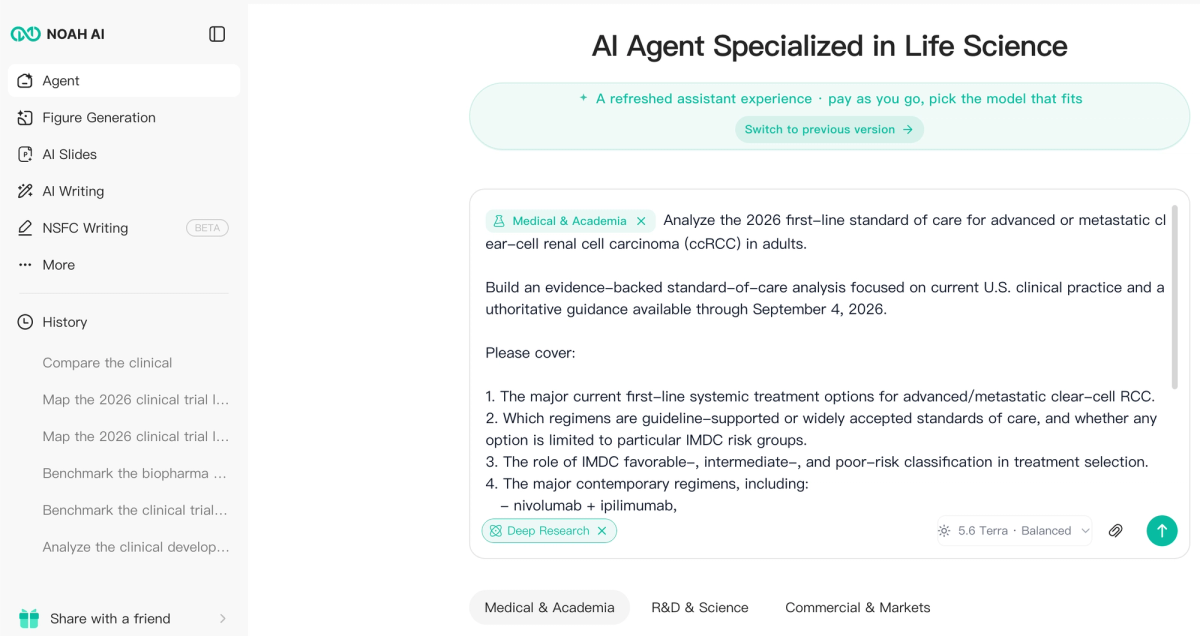
Noah's updated Agent experience makes the research setup more explicit.
The refreshed interface now lets users define the biomedical task, choose a research domain, select a research mode, and choose the model or reasoning level that fits the task.
For this standard-of-care analysis, we used:
- Agent
- Medical & Academia
- Deep Research as the research workflow
- 5.6 Terra · Balanced for this run
This is useful for practical research work because not every question needs the most expensive reasoning configuration. A focused SOC question can still be structured around authoritative guidance, labels, and pivotal evidence without turning every query into a full exhaustive research project.
We asked Noah to distinguish:
- current guideline-supported treatment,
- FDA labeling,
- pivotal clinical evidence,
- historical options,
- and clinical treatment-selection interpretation.
What Noah Returned: A Decision Framework, Not a Drug Ranking
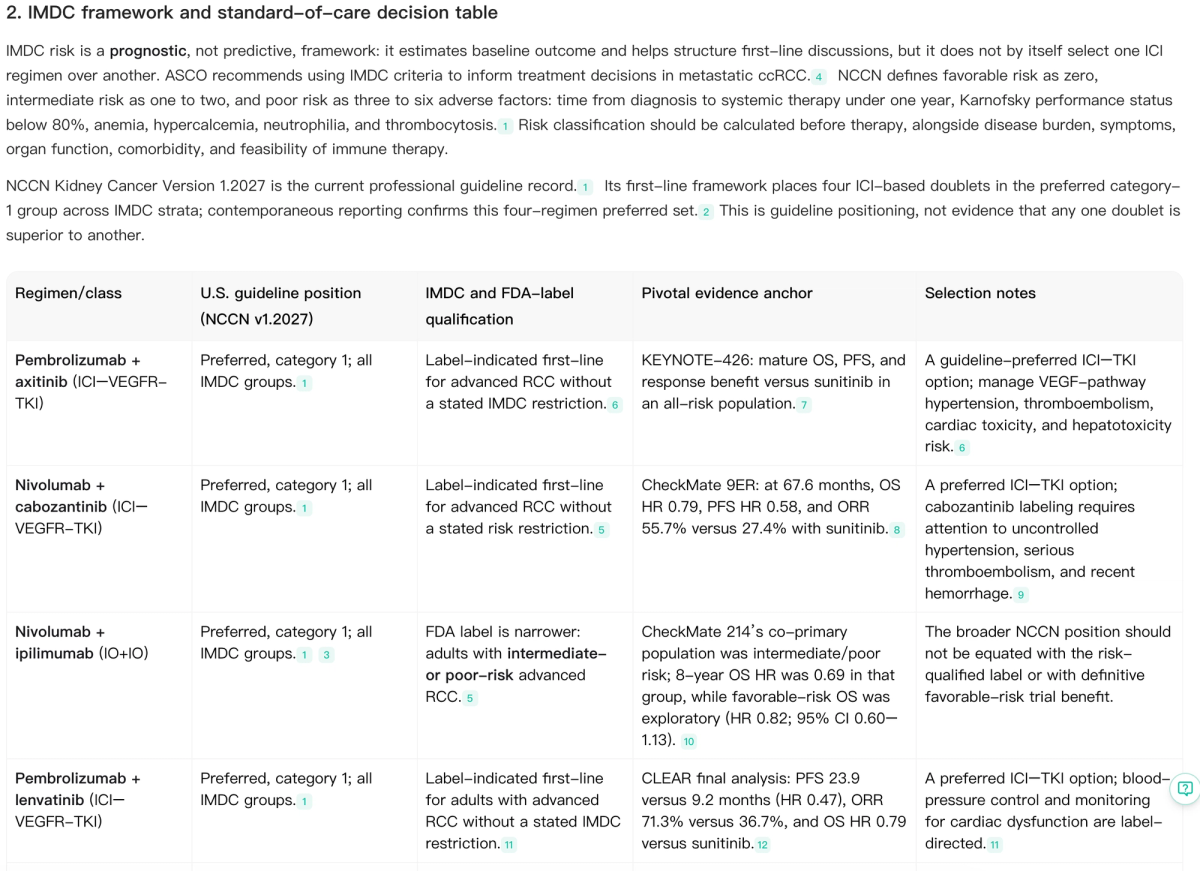
The most useful part of the output was the IMDC framework and standard-of-care decision table.
Instead of arranging drugs by a single efficacy metric, the output aligned each regimen across:
- U.S. guideline position,
- IMDC and FDA-label qualification,
- pivotal evidence,
- and practical selection considerations.
Try Noah AI for Free
Use Noah AI to search, compare, and analyze biomedical evidence with AI-powered research workflows. Free credits are available, and no credit card is required to get started.
Four Decisions That Change the Standard-of-Care Choice
IMDC Risk Group
Risk group remains an important part of first-line discussion.
Nivolumab plus ipilimumab has its strongest protocol-defined pivotal evidence in intermediate- and poor-risk disease from CheckMate 214. Current guideline positioning may be broader, but the distinction between guideline recommendation and trial evidence should remain visible.
Need for Rapid Tumor Reduction
When disease is symptomatic, bulky, rapidly progressive, or threatening organ function, clinicians may place greater value on a regimen capable of producing substantial tumor shrinkage.
ICI–VEGF-TKI combinations have produced high response rates and substantial PFS improvements relative to sunitinib in their respective trials.
But this remains a clinical interpretation of separate trial datasets. There is no randomized trial showing that one contemporary ICI–TKI combination is universally superior to IO+IO for patients who need rapid cytoreduction.
Immune-Mediated Toxicity and Comorbidities
Active autoimmune disease, baseline immunosuppression, and organ transplantation may substantially change the treatment conversation.
These patients were generally underrepresented in pivotal immunotherapy trials, so treatment decisions often require more individualized specialist judgment than a simple guideline table can provide.
TKI-Related Toxicity and Patient Preference
ICI–TKI regimens introduce an additional long-term oral treatment component. Blood-pressure monitoring, hepatic function, cardiovascular risk, treatment interruptions, and oral adherence may all matter.
Some patients may prefer an IO+IO strategy that avoids continuous VEGF-TKI exposure; others may prioritize response characteristics associated with an ICI–TKI approach.
Standard-of-care analysis therefore becomes a preference-sensitive decision, not just a guideline lookup.
Where Surgery and Local Therapy Still Fit
Systemic therapy is only part of the standard-of-care picture.
Cytoreductive nephrectomy is no longer assumed to be routine for every patient presenting with metastatic ccRCC.
Instead, nephrectomy may be considered selectively based on performance status, metastatic burden, resectability, symptoms, and the need for immediate systemic therapy.
Metastasectomy, stereotactic body radiation therapy, or ablation may also have a role in carefully selected oligometastatic settings.
This is another reason a complete SOC analysis should examine the treatment pathway, not only a drug list.
Which AI Tool Fits Which Part of Standard-of-Care Research?
| Research Need | Best-Fit Tool or Source | Why |
|---|---|---|
| Confirm current guideline recommendations | NCCN / ASCO / authoritative guidelines | Primary source for current treatment recommendations, categories, and clinical guidance. |
| Turn the clinical question into a cited decision framework | Noah AI | Useful when the task needs to connect guidelines, FDA labels, pivotal trials, patient context, and treatment-selection logic. |
| Review many scientific studies systematically | Elicit | Useful for structured evidence review, paper screening, and repeated extraction across a larger literature set. |
| Investigate a focused clinical evidence question | Consensus | Useful for literature-first questions and rapid synthesis of peer-reviewed evidence. |
| Inspect individual pivotal papers | SciSpace | Useful when trial methods, subgroup findings, endpoint definitions, or supplementary details need close review. |
| Research across guidelines, web sources, files, and papers | ChatGPT Deep Research | Useful for broad multi-source research when the task extends beyond the medical literature alone. |
| Rapidly identify recent public updates | Perplexity Research | Useful for current-source discovery before verification against primary clinical sources. |
What Researchers Still Need to Verify
Standard-of-care analysis is particularly sensitive to time and geography. Before using an AI-generated review for a formal clinical or strategic decision, researchers should verify:
- the exact guideline version and publication date,
- whether the recommendation applies to the United States or another jurisdiction,
- current FDA prescribing information,
- the patient's IMDC risk group,
- whether a pivotal analysis was prespecified or exploratory,
- whether an efficacy comparison is randomized or cross-trial,
- contraindications and important comorbidities,
- drug-specific monitoring and dose-modification requirements,
- and whether a regimen is preferred, recommended, historical, or appropriate only in selected circumstances.
Frequently Asked Questions
What is standard-of-care analysis?
Standard-of-care analysis evaluates which treatments are currently supported by authoritative guidance and clinical evidence for a defined patient population and treatment setting.
Does standard of care mean there is one best treatment?
No. Many disease settings have several guideline-supported options. Treatment choice may depend on risk group, disease burden, comorbidities, safety profile, treatment goals, and patient preference.
Can AI determine the best first-line RCC regimen?
AI can organize guideline recommendations, labels, pivotal evidence, and decision factors. It should not replace clinician judgment or present separate pivotal trials as though they were direct head-to-head comparisons.
Why is IMDC risk important in metastatic ccRCC?
IMDC provides prognostic risk classification and helps structure first-line treatment discussions. It is not a validated standalone algorithm that automatically chooses one ICI regimen.
Why should FDA labeling and guideline recommendations be separated?
Regulatory labeling and professional guidelines answer related but different questions. A guideline may recommend a treatment in a broader clinical context than the exact population described in the FDA indication.
Can cross-trial response rates be used to rank RCC treatments?
Not reliably. Separate trials can differ in patient populations, follow-up, endpoints, risk distribution, treatment exposure, and subsequent therapy. A numerical comparison across trials is not equivalent to randomized head-to-head evidence.
Final Takeaway
Standard-of-care analysis is not a search for the drug with the largest number in a trial abstract.
It is a structured clinical research task that connects guideline position, regulatory labeling, pivotal evidence, patient characteristics, treatment strategy, and uncertainty.
In advanced clear-cell RCC, several ICI-based combinations belong to the contemporary first-line standard-of-care framework, but no current randomized evidence establishes one universal winner across all patients.
Noah AI is useful when researchers want to begin with that clinical question and turn guidelines, labels, and trial evidence into a structured, reviewable decision framework.
Standard of care is a treatment framework, not a leaderboard.
Related Research Guides
Best AI Tools for Clinical Trial Results Analysis (2026)
How to Analyze Clinical Trial Results with AI Using Noah AI
Best AI Tools for Turning Research Questions into Evidence Tables (2026)
Best AI Tools for Medical Literature Search and Research Writing (2026)
Best Elicit Alternatives for Biomedical Literature Review (2026)