AI Agents for Biomedical Research: How Noah Turns Medical Evidence Into Research Workflows
Linda
Learn how Noah supports biomedical research workflows with PubMed Search, Health Search, multi-step Agent research, evidence synthesis, and structured cited outputs.
Biomedical AI agents can search faster, compare more sources, and produce increasingly sophisticated research outputs. But in life sciences, fluent answers are not enough. Researchers need to know which study supports a claim, whether the evidence is current, how populations and endpoints differ, and where uncertainty remains.Noah approaches this problem by combining focused evidence discovery with multi-step research workflows. PubMed Search and Health Search help researchers find relevant biomedical and clinical evidence, while Agent is designed to connect multiple research steps into a cited, reviewable output.
Why Research Agents Need an Evidence Layer
A useful research agent should do more than summarize webpages. It should preserve the connection between a conclusion and the underlying evidence. In biomedical research, that means retaining source context, study design, population, endpoint, limitations, and the distinction between primary studies, reviews, guidelines, trial records, and other evidence types.This matters because a result can be statistically persuasive but still poorly matched to the decision at hand. A study may involve the wrong patient population, a different comparator, a shorter follow-up period, or an endpoint that does not answer the actual development question. A research workflow therefore needs both retrieval and structured interpretation.It also needs to make disagreement visible. Mixed evidence should not be collapsed into one confident conclusion. Gaps, conflicts, indirect evidence, and weakly supported claims are part of the research result, not noise to remove.
The Research Capabilities
PubMed Search
PubMed Search is useful when the task is focused biomedical paper discovery. Researchers can use it to find relevant studies, narrow the evidence set, inspect source-backed summaries, and compare papers around a defined mechanism, disease, intervention, or outcome.
Health Search
Health Search adds trusted medical context such as guidelines, institutional resources, and current clinical information. It is useful when the research question requires more than published papers—for example, when a team needs to understand how clinical guidance, regulatory context, or medical practice relates to the literature.
Agent
Agent is intended for multi-step research. Instead of relying on one search instruction, it can clarify the scope, plan the work, retrieve evidence from multiple source types, compare findings, check coverage, and organize the final output into cited reports and structured tables.
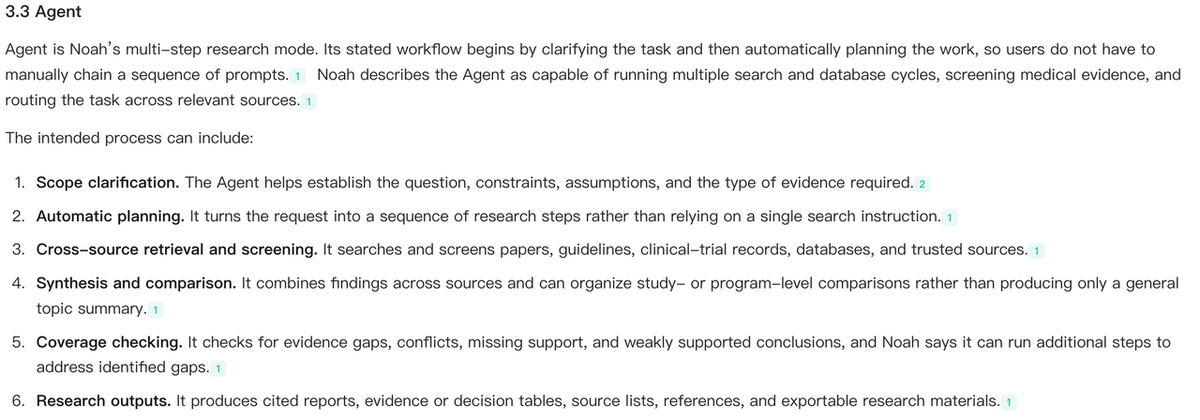
Noah Agent can structure a research task into scope clarification, planning, cross-source retrieval, synthesis, coverage checking, and cited outputs.The value is greatest when the question depends on relationships between evidence sources. A target assessment, for example, may require mechanism papers, human disease evidence, trial records, competitor programs, and biomarkers. Agent can organize those pieces into a connected research workflow instead of treating them as separate searches.
Medical & Pharma Databases
For development and portfolio questions, biomedical literature alone is often not enough. Clinical-trial records, drug-development information, competitive intelligence, patents, and other professional sources can add context around program maturity, differentiation, and strategic risk.
Search Finds Evidence. Agent Turns It Into Research.
Search and Agent solve different parts of the research process. Search works best when the question and evidence type are already bounded. Agent is better suited to connected investigations that require multiple linked sub-questions and a research deliverable.
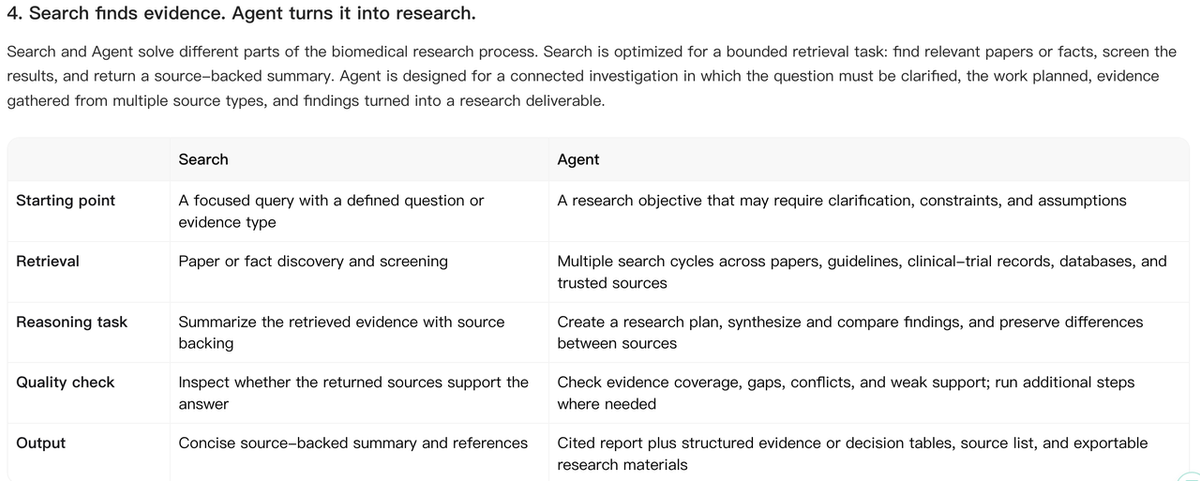
Search is suited to focused evidence retrieval; Agent is designed for multi-step investigations that combine retrieval, comparison, coverage checking, and structured outputs.Practical rule: use Search when you need a focused set of papers, facts, or clinical context. Use Agent when the question spans several evidence streams and the final output needs to be a research artifact rather than a short answer.Free to use · Free credits included · No credit card requiredStart a Biomedical Research Workflow with Noah AI →
What Researchers Can Build With Noah
- Target Evaluation
A target-evaluation workflow can move from target biology → disease association → clinical validation → competitive landscape → biomarker strategy → final target assessment.For a target such as TL1A/TNFSF15, the final output can include a clinical-validation table, competitor landscape, biomarker assessment, evidence gaps, and an explicit ADVANCE, HOLD, or DEPRIORITIZE recommendation.
- Indication Strategy
An indication-strategy workflow can connect unmet need → epidemiology → mechanism → clinical competition → biomarker segmentation → development strategy.In severe asthma, for example, the question is not simply whether TSLP biology works. The more useful strategic question is which patients remain poorly served, how crowded the biologic landscape is, and what a new entrant would need to differentiate.
- Literature Review
A literature-review workflow can progress from research question → search → screening → study comparison → evidence table → synthesis → citation audit.This is particularly useful when researchers need a structured review rather than a general summary. The key output is not just prose, but a source-linked record of how the evidence was organized and compared.
- Competitive Intelligence
A competitive-intelligence workflow can connect mechanism → assets → clinical evidence → resistance → combinations → competitive positioning.For RAS-targeted therapy in pancreatic cancer, that can mean linking molecular strategy with development stage, trial evidence, resistance mechanisms, combination logic, and the remaining differentiation opportunity.
Integrating Noah Into Broader Research Workflows
Noah is most useful as a research layer within an existing scientific or portfolio process. A practical workflow is to define the decision and evidence requirements first, run focused Search or deeper Agent research second, inspect the sources and unresolved gaps third, and then review the structured output with subject-matter experts.For teams using Noah alongside other internal systems, the most important requirement is to preserve traceability. Keep the search date, research scope, source list, structured evidence tables, reviewer changes, and unresolved questions with the project record so the work can be revisited when new evidence appears.Noah product information also references API calls at a high level. Teams considering programmatic integration should confirm current implementation details, permissions, and supported workflows directly with Noah before building production automation.
Get Started
Start with the research task, not the tool. Use PubMed Search when you need focused paper discovery and source-backed evidence. Use Health Search when the question requires trusted medical context. Move to Agent when the work requires several connected research steps, multiple evidence types, comparison, coverage checking, and a structured cited output.
Run a Biomedical Research Workflow with Noah AI
Use Noah AI to turn a biomedical research question into a structured, source-linked investigation across literature, clinical evidence, and related research materials.Free to use · Free credits included · No credit card requiredStart a Biomedical Research Workflow with Noah AI →
Related Research Guides
- Best AI Tools for PubMed Literature Review (2026)
- Best AI Tools for Research Evidence Tables (2026)
- Best AI Tools for Clinical Trial Results Analysis (2026)
- PubMed Search with AI
This article describes research workflows and product capabilities. Researchers remain responsible for verifying important claims against original sources and applying formal systematic-review methods where required.