How to Prepare a Target Product Profile with Noah AI
Linda
Learn how Noah AI helps biopharma, clinical development, BD, and product strategy teams organize indication, target population, efficacy goals, safety expectations, dosing assumptions, differentiation, and evidence gaps into a structured target product profile.
A target product profile is one of the most important planning documents in biopharma product strategy and clinical development. It defines what a future product should become, including the target indication, patient population, route of administration, efficacy goals, safety expectations, dosing assumptions, differentiation, and evidence requirements.The challenge is that TPP development requires teams to connect scientific rationale, clinical evidence, unmet need, competitive context, regulatory expectations, and commercial strategy. Without a structured framework, teams may describe a product concept without clearly defining what success should look like or which evidence gaps must be addressed.Noah AI helps teams prepare a structured target product profile by turning a product concept into a review-ready framework. Users can define the product idea, indication, patient population, desired attributes, development considerations, and evidence requirements, then use Noah AI to organize the output into a structured TPP for internal discussion and expert validation.
Why Target Product Profiles Are Difficult to Prepare
Target product profiles are difficult because they sit between science, clinical development, regulatory strategy, product strategy, BD, and commercial planning. Each team may care about a different part of the same product concept. A clinical development team may focus on endpoints and patient eligibility, while a commercial or BD team may focus on differentiation, future positioning, and evidence gaps.The difficult part is not writing a product description. It is defining the product attributes that must be achieved, the evidence required to support them, and the risks that could change the development strategy.For a next-generation oral GLP-1 receptor agonist, teams may need to consider target indications, target patient segments, expected efficacy, safety and tolerability expectations, dosing convenience, differentiation versus injectable therapies, regulatory expectations, and the competitive development landscape. Without a clear framework, a TPP can easily become a broad product vision rather than a practical development planning document.
What Should a Target Product Profile Include?
- Target indication
- Target patient population
- Mechanism of action
- Route of administration
- Dosing assumptions
- Efficacy goals
- Safety expectations
- Differentiation versus current therapies
- Clinical development considerations
- Regulatory considerations
- Evidence gaps
- Key risks and validation needs
How Noah AI Supports Target Product Profile Development
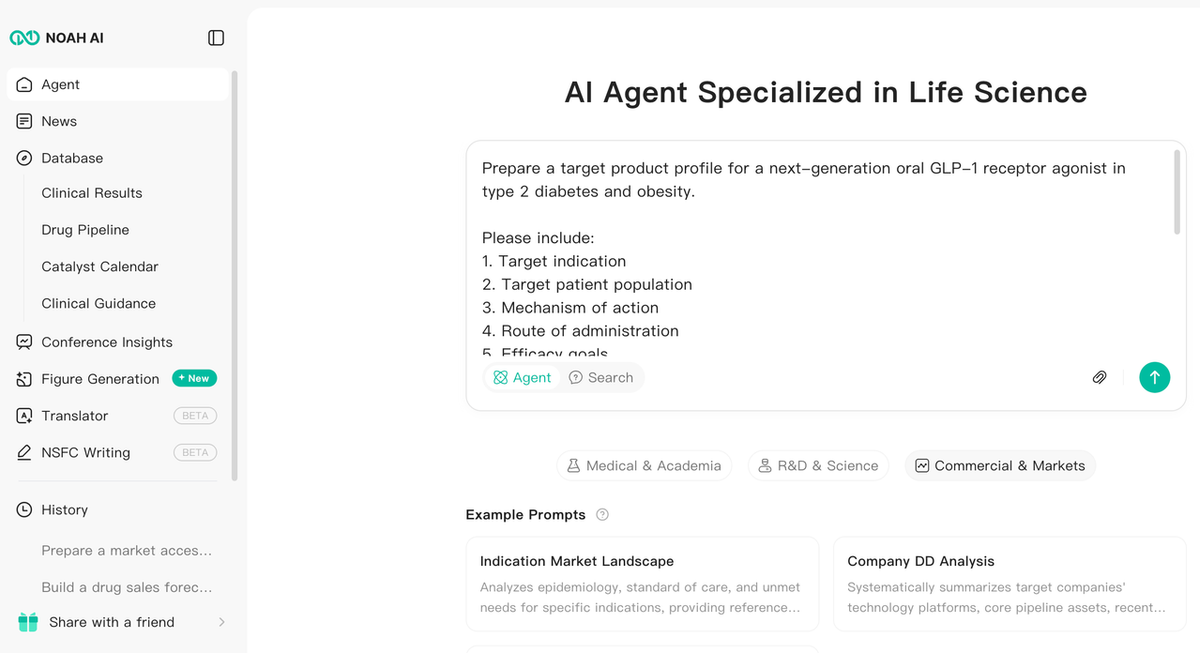
Noah AI is useful because TPP preparation starts from a structured product strategy and clinical development question, not a blank document. Users can define the product concept, indication, patient population, desired attributes, evidence needs, and risks, then use Noah AI to organize these inputs into a review-ready TPP framework.In the example workflow, the user asks Noah AI to prepare a target product profile for a next-generation oral GLP-1 receptor agonist in type 2 diabetes and obesity. The prompt asks for indication, target population, mechanism, route, efficacy goals, safety expectations, dosing assumptions, differentiation, development considerations, regulatory considerations, evidence gaps, risks, and traceable references.This makes the output more useful for internal discussion because the TPP can be reviewed as a structured set of product attributes rather than a loose summary of the market or disease area.
Step 1: Define the Product Concept, Indication, and Development Scope
The first step is to define the product concept clearly. A target product profile should not begin with a vague therapeutic area. It should specify the product type, target indication, patient population, intended use setting, and development scope.For example, a user can ask Noah AI to prepare a TPP for a next-generation oral GLP-1 receptor agonist in type 2 diabetes and obesity. By asking for efficacy goals, safety expectations, route of administration, differentiation, regulatory considerations, and evidence gaps, the user gives Noah AI a clear framework for organizing the output.
Step 2: Organize Target Population, Efficacy Goals, and Safety Expectations
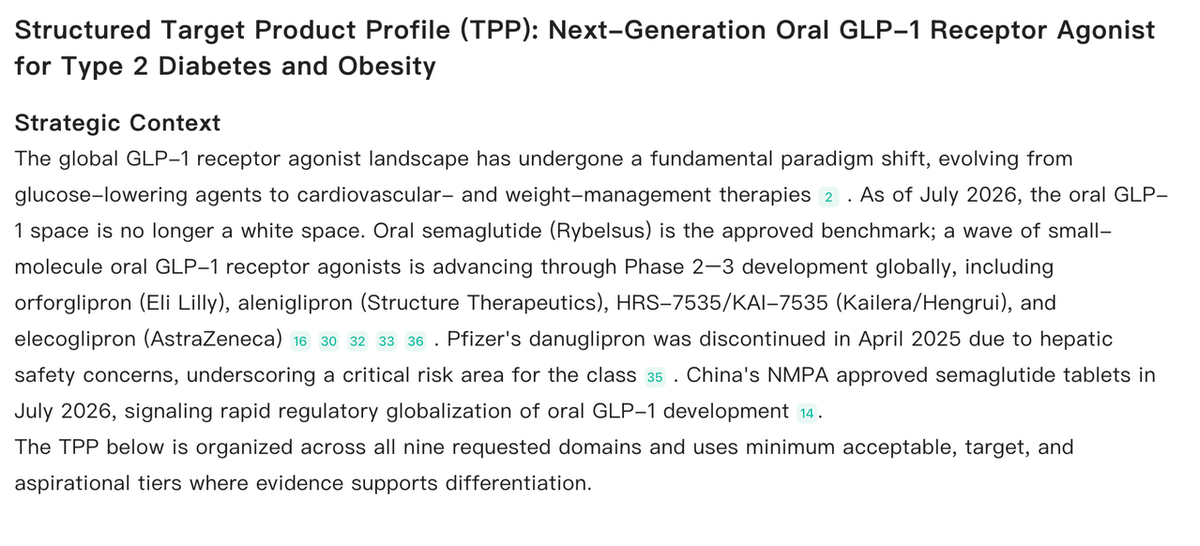
After the product concept is defined, the next step is to connect the product profile to a strategic and clinical development context. Noah AI can summarize why the product concept matters, how the current treatment landscape is evolving, and which development risks may shape the product strategy.In the example output, Noah AI generates a strategic context summary for a next-generation oral GLP-1 receptor agonist. This helps teams understand how the TPP relates to treatment convenience, competitive differentiation, safety concerns, and broader development activity.
Step 3: Compare Differentiation, Development Considerations, and Evidence Gaps
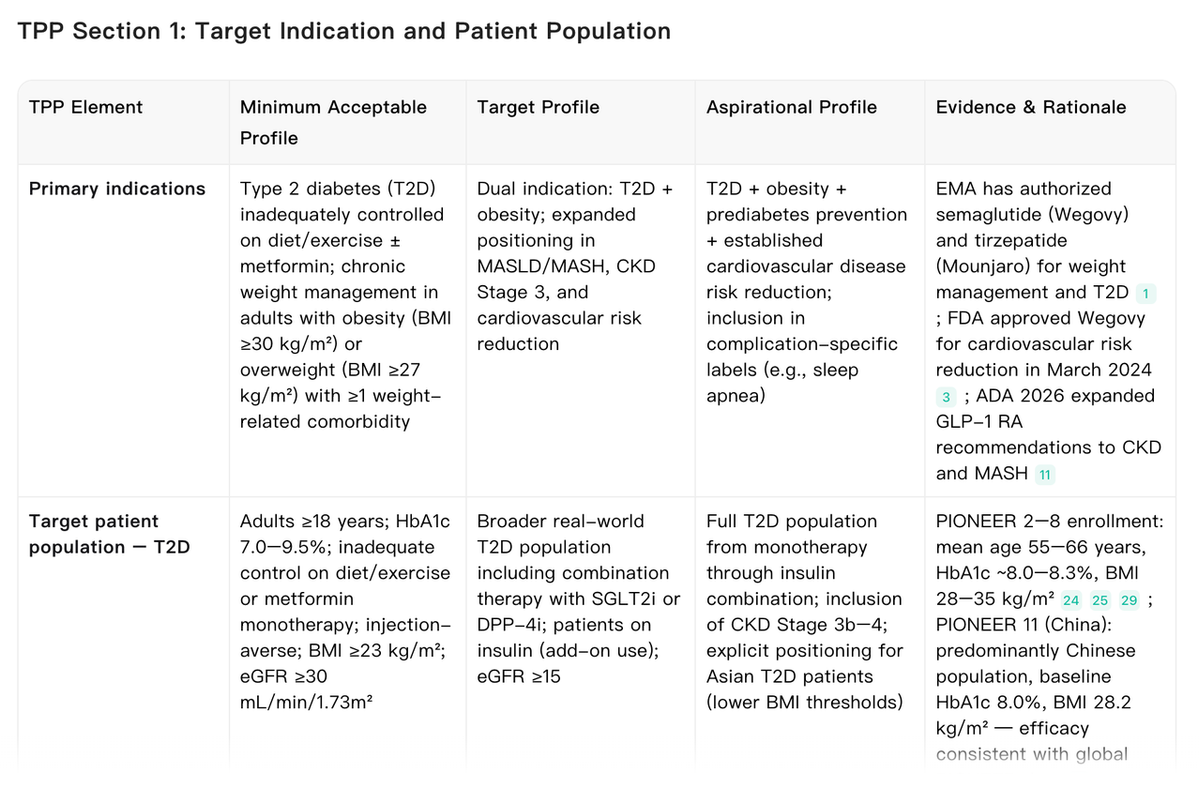
A target product profile should not only list ideal product attributes. It should show what is minimally acceptable, what the target profile should be, what an aspirational profile could look like, and what evidence is needed to support each claim.Noah AI can organize these elements into a structured TPP table. In the example output, the table compares minimum acceptable, target, and aspirational product profiles for indication and patient population, while also including evidence and rationale. This type of structure helps teams discuss tradeoffs, identify validation needs, and align around development priorities.
Target Product Profile Sections and How Noah AI Supports Them
| TPP Section | What It Defines | How Noah AI Helps |
|---|---|---|
| Target population | Eligible patients and use setting | Organizes patient scope and treatment context |
| Product profile | Mechanism, route, dosing, and goals | Structures desired product attributes |
| Differentiation | Why the product may matter | Compares potential advantages and unmet needs |
| Evidence gaps | What still needs validation | Highlights risks and development questions |
When Should Teams Use Noah AI for TPP Preparation?
Biopharma teams can use Noah AI when they need to prepare a structured TPP draft before deeper internal review. This can be useful during early product strategy work, translational planning, clinical development design, BD opportunity assessment, competitive positioning, and evidence gap review.Noah AI is especially useful when teams need to turn a broad product idea into a structured product profile. The output can help teams align on what the product should achieve, what evidence is required, and what risks need to be validated before development decisions are finalized.
Final Takeaway
A target product profile is not just a product description. It is a structured planning document that defines what a future product should become and what evidence is needed to support that vision.Noah AI helps biopharma teams prepare review-ready TPP frameworks by organizing indication, patient population, mechanism, dosing, efficacy goals, safety expectations, differentiation, development considerations, and evidence gaps. The result is a clearer starting point for product strategy discussion and expert validation.Ready to prepare a structured target product profile? Try Noah AI.
FAQ
What is a target product profile?A target product profile is a structured document that defines the desired attributes of a future product, including indication, target population, efficacy goals, safety expectations, dosing, differentiation, and evidence requirements.How does Noah AI help prepare a target product profile?Noah AI helps users define the product concept, indication, patient population, desired attributes, development considerations, and evidence gaps, then organizes the output into a structured TPP framework.Who can use Noah AI for TPP preparation?Biopharma product strategy teams, clinical development teams, BD teams, translational medicine teams, commercial strategy teams, and research teams can use Noah AI to support TPP preparation.Can Noah AI replace product strategy or clinical development experts?No. Noah AI can help organize product strategy information and evidence gaps, but final TPP decisions should be reviewed by qualified clinical, scientific, regulatory, commercial, and development experts.Can Noah AI identify evidence gaps in a TPP?Yes. Noah AI can help structure evidence gaps, development risks, and validation questions, but teams should verify outputs against original evidence, regulatory guidance, and internal strategy assumptions.
Research and Development Disclaimer
This article is intended for research workflow education only. AI-generated target product profiles should not be used as final clinical development strategy, regulatory guidance, investment advice, commercial strategy, or medical decision-making without expert review.Teams should validate all outputs against original clinical evidence, regulatory guidance, competitive intelligence, internal assumptions, and expert judgment before using them in formal product strategy or development planning.