How to Analyze Payer Objections with Noah AI
Linda
Learn how Noah AI helps market access, HEOR, payer strategy, and commercial teams analyze payer objections, reimbursement risks, evidence gaps, access
Introduction
Payer objections can shape whether a therapy receives broad coverage, restricted access, prior authorization requirements, or unfavorable reimbursement positioning. For biopharma teams, the challenge is not only understanding what payers may object to, but also identifying which evidence is available, which gaps remain, and how those concerns should be addressed.In specialty and high-cost therapeutic areas, payer objections often involve budget impact, patient eligibility, diagnostic requirements, treatment duration, comparative effectiveness, real-world outcomes, and long-term value. These concerns are especially important when a product is supported by surrogate endpoints, has a large eligible population, or enters a market with evolving standards of care.Noah AI helps teams analyze payer objections by turning a product and indication question into a structured market access workflow. Users can define the product, payer context, reimbursement concerns, evidence needs, and strategic response requirements, then use Noah AI to organize objections, evidence gaps, access risks, and response options into a review-ready framework.
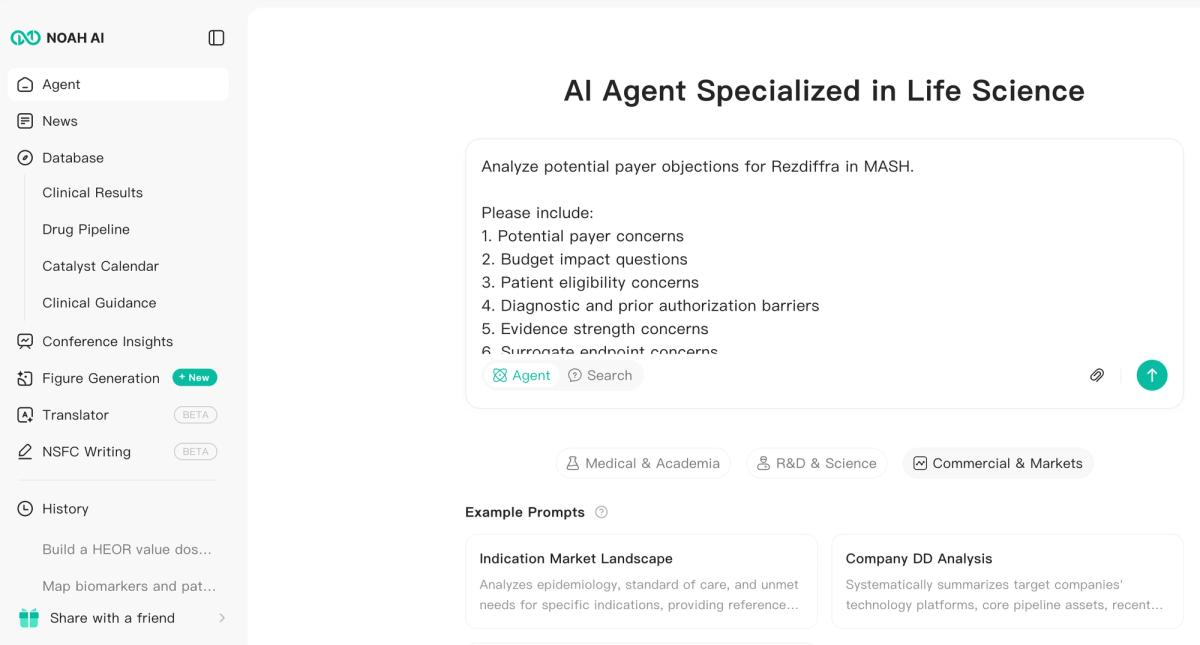
Figure 1. Users can start payer objection analysis in Noah AI by defining the product, indication, payer concerns, evidence needs, reimbursement barriers, access risks, and response strategy requirements.
Why Payer Objections Are Difficult to Analyze
Payer objections are difficult because they sit at the intersection of clinical evidence, reimbursement policy, economic value, utilization management, and real-world implementation. A payer may not object to the existence of clinical benefit, but may still question whether the benefit is large enough, durable enough, measurable enough, or cost-effective enough to justify broad access.For Rezdiffra in MASH, the objection landscape is especially complex. The therapy addresses a major unmet need in noncirrhotic MASH with moderate-to-advanced fibrosis, but payers may still raise questions about surrogate endpoints, long-term outcomes, diagnostic confirmation, prior authorization burden, GLP-1 competition, patient affordability, and budget impact.The difficult part is not listing payer concerns. It is connecting each objection to the payer rationale, likely access control, evidence needed, strategic response, and risk level.
How Noah AI Supports Payer Objection Analysis
Noah AI is useful because payer objection analysis starts from a structured market access question, not a blank document. Teams can define the product, indication, payer concerns, reimbursement barriers, access risks, and evidence response requirements, then use Noah AI to organize the output into an objection-response framework.In the example below, Noah AI generates an executive summary for a Rezdiffra payer objection analysis. The summary connects coverage status, prior authorization requirements, surrogate endpoint concerns, competitive pressure, and evidence needs into one market access view.
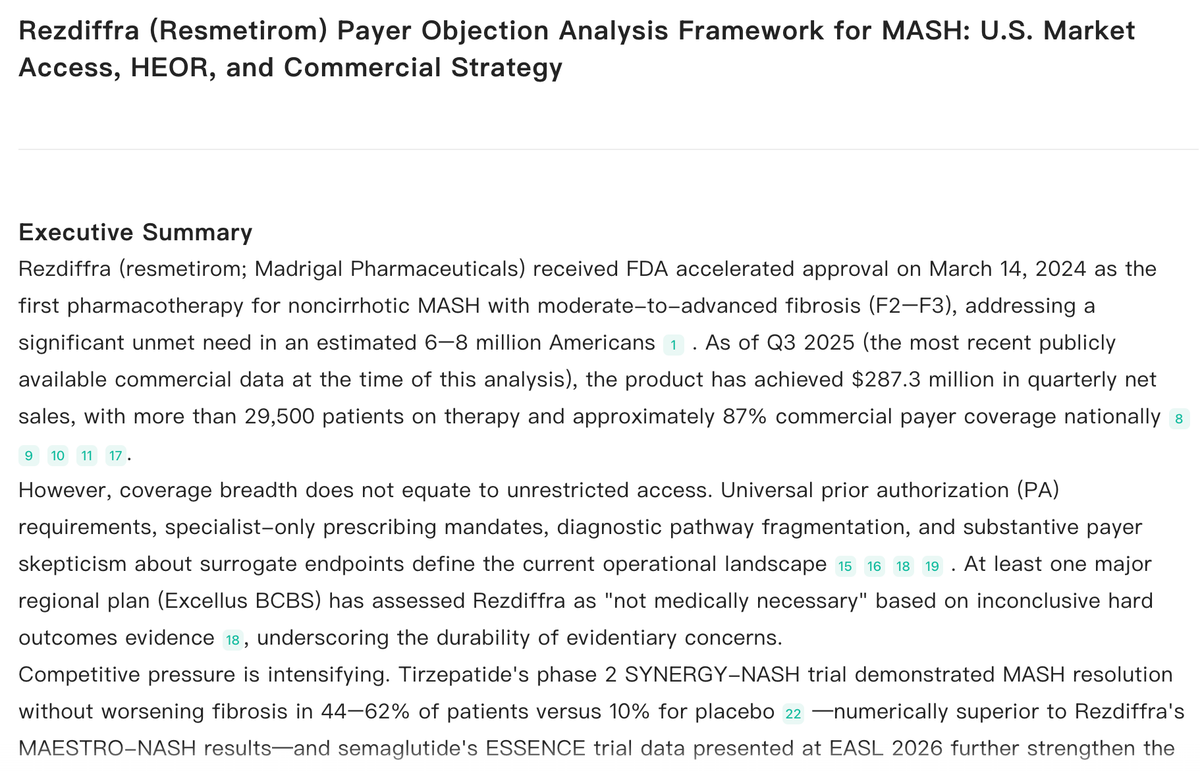
Figure 2. Noah AI summarizes payer objections by connecting coverage status, prior authorization requirements, surrogate endpoint concerns, budget impact, competitive pressure, and evidence needs.
What Should a Payer Objection Analysis Include?
- Potential payer concerns and reimbursement objections
- Budget impact questions and utilization management risks
- Patient eligibility concerns and diagnostic requirements
- Prior authorization barriers and reauthorization criteria
- Evidence strength concerns, including surrogate endpoint questions
- Reimbursement barriers, access restrictions, and affordability issues
- Evidence needed to address each objection
- Strategic response options and key risk levels
Step 1: Define the Product, Indication, and Payer Context
The first step is to define the therapy, indication, payer environment, and access questions. For this example, the workflow focuses on Rezdiffra in MASH and asks Noah AI to analyze payer concerns, budget impact, diagnostic barriers, evidence strength, surrogate endpoint concerns, reimbursement risks, and response strategies.This step matters because a payer objection analysis should be specific. A general market access summary may identify broad barriers, but an objection framework should connect each concern to the type of payer decision it may influence.
Step 2: Identify Budget, Eligibility, Diagnostic, and Evidence Concerns
Payers often evaluate therapies through several lenses at the same time. They may ask whether the eligible population is clearly defined, whether diagnostic criteria can be verified, whether prior authorization rules are operationally feasible, whether long-term outcomes are established, and whether the product competes with or complements other therapies.Noah AI can help teams organize these concerns into a more reviewable structure, so market access, HEOR, commercial, and medical teams can see which objections are clinical, economic, operational, or evidence-related.
Step 3: Map Evidence Gaps and Response Strategies
The most important part of payer objection analysis is not only naming the objection. Teams also need to identify what evidence is already available, what evidence is missing, how the objection may affect access, and which response strategy should be prepared.In the example below, Noah AI organizes core clinical value objections into a structured table. Even though the screenshot is partially cropped on the right, the visible columns still show the key workflow: payer objection, rationale, payer type, likely access control, and evidence needed.
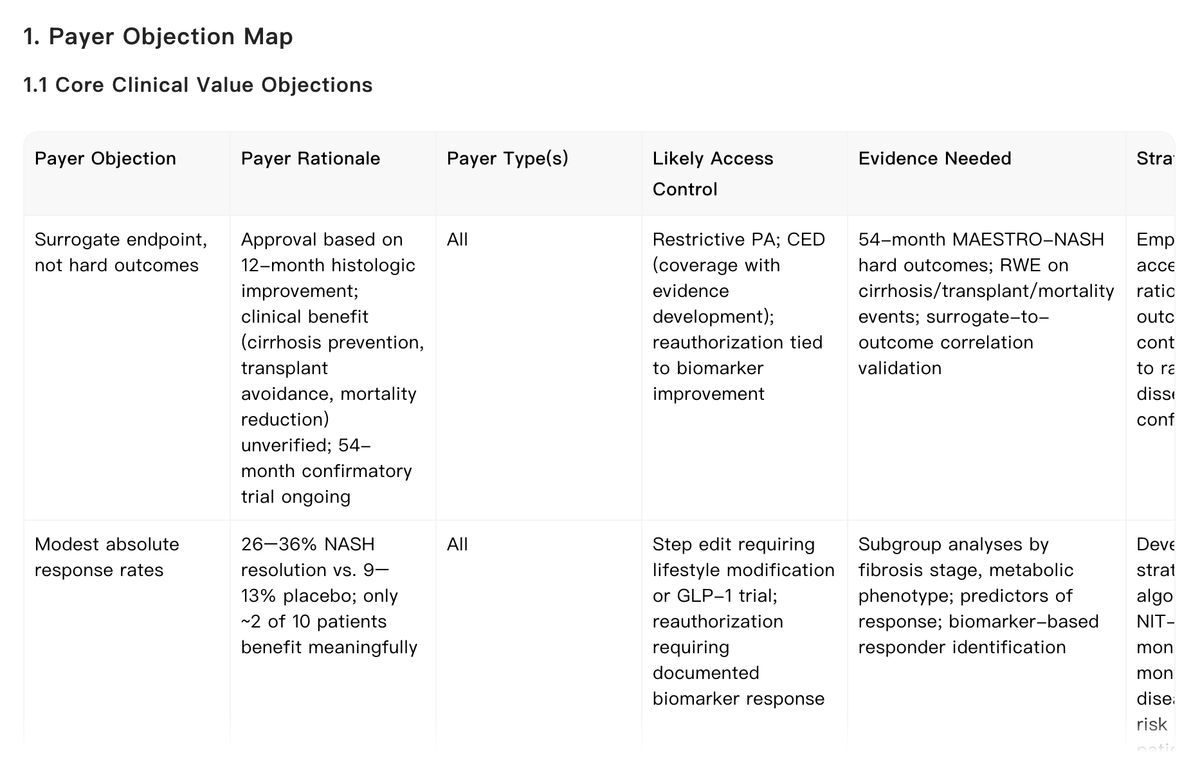
Figure 3. Noah AI organizes payer objections into a structured table covering payer rationale, likely access controls, evidence needs, strategic responses, and risk levels.
Table: Payer Objection Areas and How Noah AI Supports Them
| Objection Area | Why It Matters | How Noah AI Helps |
|---|---|---|
| Budget impact | Large eligible populations can create coverage and utilization concerns. | Organizes market size, utilization, cost, and uptake questions. |
| Eligibility criteria | Payers need clear patient selection rules before broad coverage. | Maps indication, diagnostic requirements, prior authorization, and treatment criteria. |
| Evidence strength | Coverage decisions depend on credible value evidence and outcome uncertainty. | Summarizes available evidence and identifies gaps such as surrogate endpoint limitations. |
| Response strategy | Teams need evidence-based responses to payer concerns. | Structures objection-response logic for review by HEOR, market access, and commercial teams. |
When Should Teams Use Noah AI for Payer Objection Analysis?
- Before payer advisory boards or payer research interviews
- When preparing market access or reimbursement strategy materials
- When a therapy may face prior authorization or step therapy restrictions
- When evidence is based on surrogate endpoints and long-term outcomes are still pending
- When commercial, HEOR, medical affairs, and payer strategy teams need a shared objection-response framework
- When teams need to identify evidence gaps before value communication, HTA engagement, or launch planning
Final Takeaway
Payer objection analysis is not only about predicting what payers may say. It is about preparing a structured view of payer concerns, evidence gaps, likely access controls, and evidence-based response strategies.Noah AI helps teams turn payer questions into a review-ready framework by organizing budget impact, eligibility criteria, diagnostic requirements, prior authorization barriers, evidence strength, surrogate endpoint concerns, reimbursement risks, and strategic responses.Noah AI does not replace payer research, market access judgment, HEOR modeling, legal review, or compliance review. It gives teams a stronger starting point for structured payer objection analysis and cross-functional discussion.
FAQ
What are payer objections?
Payer objections are concerns raised by payers or reimbursement decision-makers about whether a therapy should receive coverage, under what conditions, for which patients, and at what level of access.
How does Noah AI help analyze payer objections?
Noah AI helps users define the product, indication, payer context, evidence needs, and reimbursement concerns, then organizes payer objections, evidence gaps, access risks, and response strategies into a structured framework.
Who can use Noah AI for payer objection analysis?
Market access teams, HEOR teams, payer strategy teams, commercial teams, medical affairs teams, BD teams, and biopharma strategy teams can use Noah AI to support payer objection analysis.
Can Noah AI replace payer research or market access experts?
No. Noah AI can help organize payer concerns and evidence gaps, but final payer strategy should be reviewed by qualified market access, HEOR, legal, compliance, medical, and commercial experts.
Can Noah AI help prepare response strategies?
Yes. Noah AI can help structure possible evidence-based responses to payer concerns, but teams should validate those responses against original evidence, payer research, local reimbursement rules, and internal compliance standards.