How to Build a HEOR Value Dossier with Noah AI
Linda
Learn how Noah AI helps HEOR, market access, medical affairs, and biopharma strategy teams organize disease burden, clinical value, economic considerations, real-world evidence needs, evidence gaps, and stakeholder questions into a structured value dossier.
Introduction
A HEOR value dossier is an important evidence document for health economics, market access, medical affairs, payer engagement, and biopharma strategy teams. It helps organize the value story behind a product by connecting disease burden, unmet need, clinical value, economic considerations, patient outcomes, real-world evidence needs, and stakeholder questions.The challenge is that HEOR inputs are often scattered across clinical trials, epidemiology sources, economic studies, real-world evidence, payer research, regulatory documents, and internal assumptions. Teams need a structured way to organize what evidence exists, what evidence is still missing, and which questions matter most for payer, HTA, and internal decision-making.Noah AI helps teams build a HEOR value dossier framework by turning a product and indication question into a structured evidence workflow. Users can define the product, disease context, value evidence scope, and stakeholder needs, then use Noah AI to organize clinical, economic, real-world, and payer-relevant evidence into a review-ready dossier framework.
Why HEOR Value Dossiers Are Difficult to Prepare
HEOR value dossiers are difficult because they sit between clinical evidence, health economics, payer strategy, outcomes research, and value communication. A useful dossier cannot simply list trial results. It needs to explain why the disease matters, which patients are affected, what value the product may provide, what evidence supports that value, and where uncertainty remains.For products in complex disease areas such as MASH, the evidence base may include fibrosis-stage progression, diagnosis pathways, quality-of-life outcomes, treatment persistence, payer access barriers, long-term outcomes, and economic burden. Each of these inputs may come from different sources and may carry different levels of evidence confidence.This is why HEOR teams need a structured dossier framework before building formal models, payer materials, or value communication documents. The framework should make assumptions visible, separate evidence from uncertainty, and identify the gaps that require validation.
What Should a HEOR Value Dossier Include?
A HEOR value dossier should usually cover the following sections:
- Disease burden and epidemiology
- Unmet medical need and treatment limitations
- Eligible patient population and treatment context
- Clinical value, safety, and patient outcomes
- Economic burden and healthcare resource use
- Real-world evidence needs and evidence generation strategy
- Payer and HTA relevance
- Evidence gaps, stakeholder questions, and key value messages
- Traceable references and claim-level evidence support
How Noah AI Supports HEOR Value Dossier Development
Noah AI is useful because HEOR dossier preparation starts from a structured value evidence question, not a blank document. Users can define the product, indication, target audience, disease context, and evidence scope, then use Noah AI to organize findings into a dossier framework that can be reviewed by HEOR, market access, medical affairs, and strategy teams.In the example workflow, the user asks Noah AI to build a HEOR value dossier framework for Rezdiffra in MASH. The output is not a final economic model or payer strategy. Instead, it is a structured starting point that helps teams organize evidence, identify gaps, and prepare expert-reviewed materials.
Step 1: Define the Product, Indication, and Value Evidence Scope
The first step is to define the product, indication, target users, evidence scope, and requested output structure. For a HEOR value dossier, this means asking for disease burden, clinical value, economic considerations, patient outcomes, real-world evidence needs, payer or HTA relevance, evidence gaps, stakeholder questions, and traceable references.This step helps Noah AI understand that the task is not a general disease summary, but a value evidence dossier for HEOR and market access review.
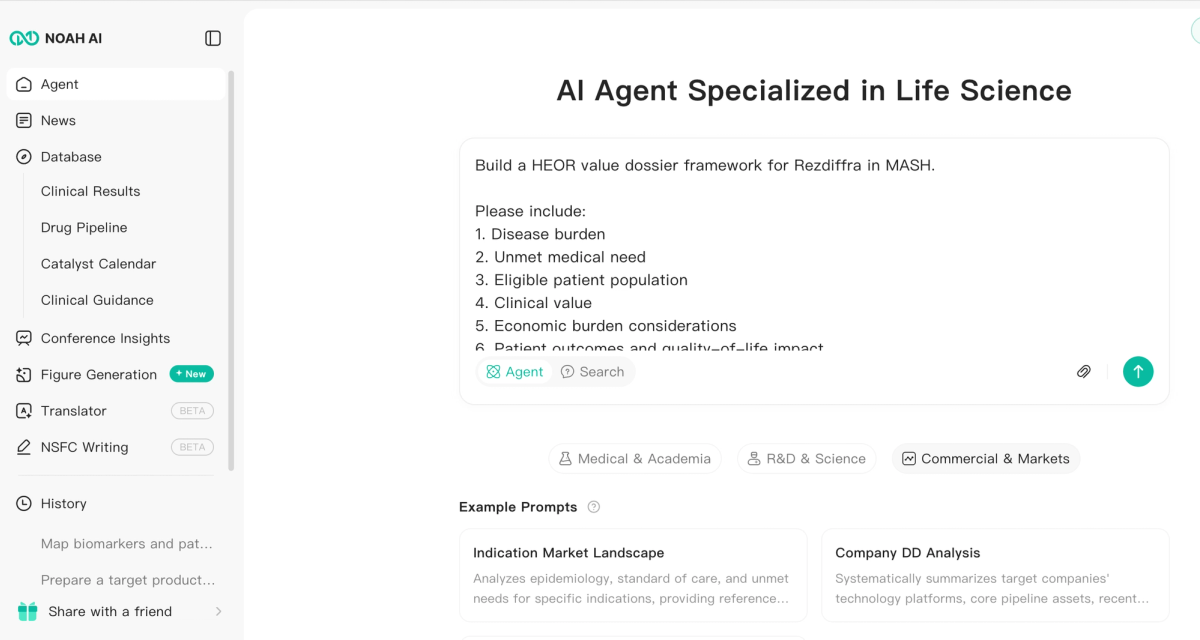
Figure 1. Users can start a HEOR value dossier in Noah AI by defining the product, indication, disease burden, clinical value, economic considerations, real-world evidence needs, and stakeholder questions.
Step 2: Organize Disease Burden, Clinical Value, and Economic Considerations
After the scope is defined, Noah AI can organize disease burden and value context into a structured dossier. For Rezdiffra in MASH, this includes the epidemiology and prevalence of MASLD/MASH, the eligible patient population, fibrosis-stage context, treatment need, and evidence timeframe.This matters because HEOR value communication needs to connect product evidence to disease burden and patient impact. A value dossier should help teams explain why the disease creates clinical and economic consequences, why a treatment may matter, and which claims still require validation.
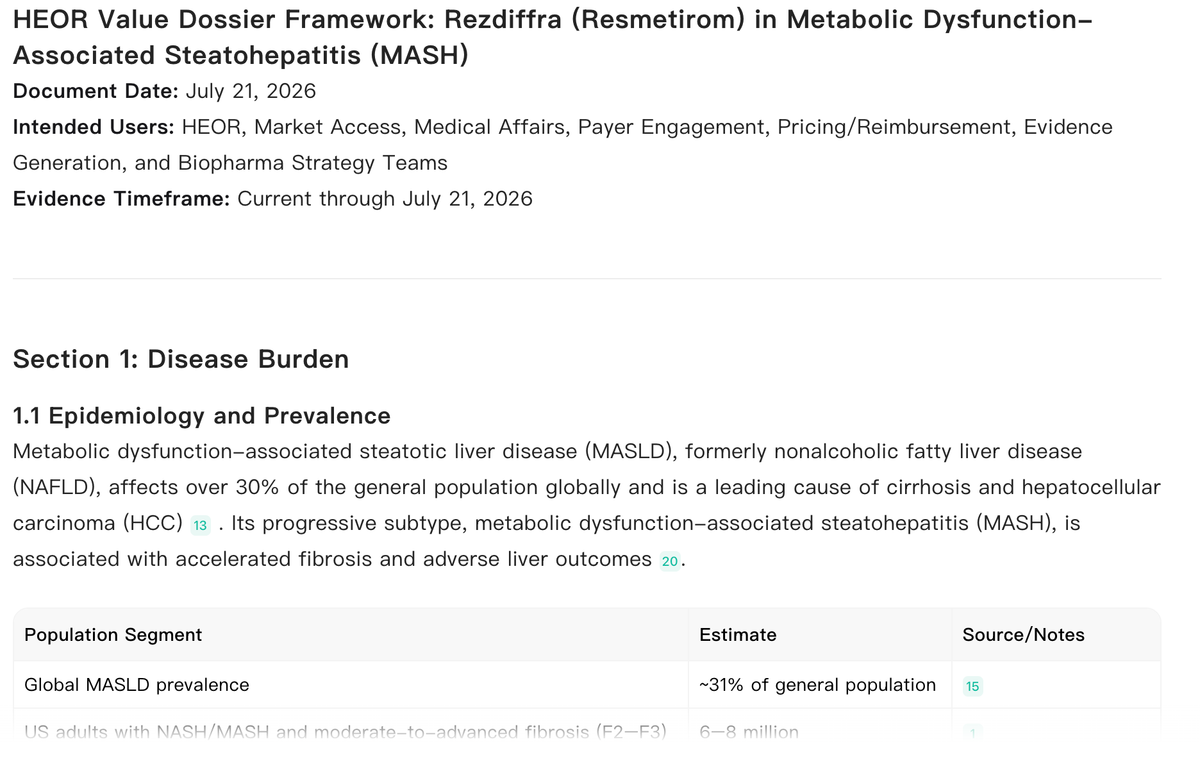
Figure 2. Noah AI generates a structured HEOR value dossier framework that organizes disease burden, intended users, evidence timeframe, and population-level context for Rezdiffra in MASH.
Step 3: Identify Real-World Evidence Needs, Evidence Gaps, and Stakeholder Questions
A strong HEOR dossier does not stop at the existing evidence. It also identifies what evidence is still needed. Real-world evidence questions may include diagnosis pathways, diagnostic modality, treatment initiation, adherence and persistence, discontinuation reasons, long-term fibrosis outcomes, clinical event reduction, comparative effectiveness, safety, access, and budget impact validation.Noah AI can help structure these questions into a reviewable table, making it easier for HEOR and market access teams to plan evidence generation priorities and prepare stakeholder discussions.
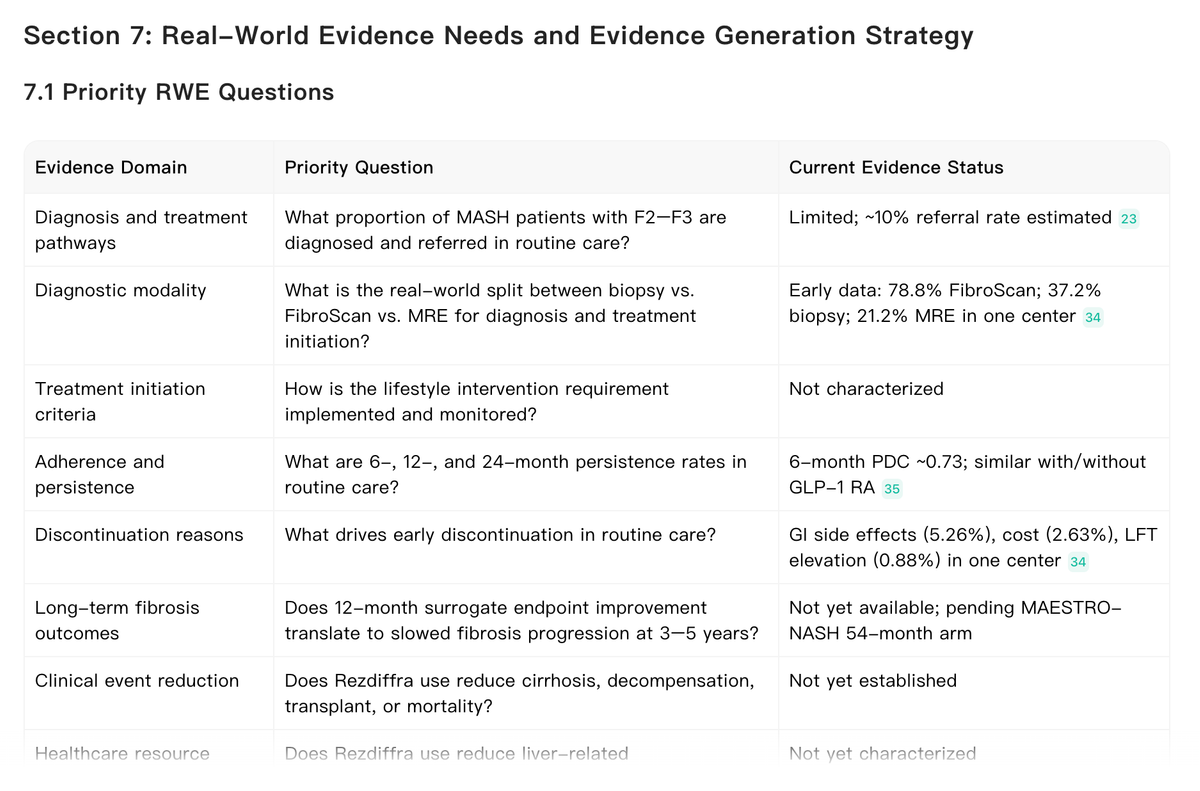
Figure 3. Noah AI organizes real-world evidence needs into a structured table covering diagnosis pathways, diagnostic modality, treatment initiation, adherence, persistence, long-term outcomes, and clinical event reduction.
HEOR Value Dossier Sections and How Noah AI Supports Them
| Dossier Section | What It Covers | How Noah AI Helps |
|---|---|---|
| Disease burden | Clinical, population, and economic impact | Summarizes burden and unmet need context |
| Clinical value | Efficacy, safety, and outcome relevance | Organizes value evidence for expert review |
| RWE needs | Evidence required beyond clinical trials | Highlights real-world evidence questions |
| Evidence gaps | Remaining uncertainty and validation needs | Structures gaps for HEOR and payer discussion |
When Should Teams Use Noah AI for HEOR Value Dossiers?
Teams can use Noah AI when they need to prepare an initial HEOR dossier framework, organize scattered evidence, identify real-world evidence needs, or translate a product and indication question into a structured value evidence brief. This can be useful before payer strategy meetings, HTA planning, medical affairs alignment, evidence generation planning, or internal commercial strategy reviews.Noah AI is especially useful when teams need to make the dossier structure visible: what evidence exists, what evidence is missing, what questions stakeholders may ask, and which claims need expert validation before being used in formal materials.
Final Takeaway
A HEOR value dossier is not just a collection of clinical data. It is a structured evidence framework that connects disease burden, clinical value, economic considerations, real-world evidence needs, payer relevance, evidence gaps, and stakeholder questions.Noah AI helps HEOR, market access, medical affairs, and biopharma strategy teams organize this evidence into a review-ready framework. The output should not replace expert review, but it can give teams a clearer starting point for value communication, evidence generation, and internal decision-making.Ready to build a reviewable HEOR value dossier framework? Try Noah AI.
FAQ
What is a HEOR value dossier?
A HEOR value dossier is a structured evidence document that organizes disease burden, clinical value, economic considerations, patient outcomes, real-world evidence needs, payer relevance, evidence gaps, and stakeholder questions for value communication and market access planning.
How does Noah AI help build a HEOR value dossier?
Noah AI helps users define the product, indication, value evidence scope, and stakeholder questions, then organizes disease burden, clinical value, economic considerations, real-world evidence needs, and evidence gaps into a structured dossier framework.
Who can use Noah AI for HEOR value dossier preparation?
HEOR teams, market access teams, medical affairs teams, commercial strategy teams, payer strategy teams, BD teams, and biopharma researchers can use Noah AI to support value dossier preparation.
Can Noah AI replace HEOR experts or economic modeling?
No. Noah AI can help organize evidence and identify gaps, but final HEOR analysis, economic modeling, payer strategy, and formal value communication should be reviewed by qualified experts.
Can Noah AI help identify real-world evidence needs?
Yes. Noah AI can help structure real-world evidence needs and evidence gaps, but teams should validate outputs against original clinical evidence, payer research, real-world datasets, local requirements, and expert judgment.